
Compact Powder Assembly: A Guide to Robotic Integration in Your Cosmetic Line
Compact Powder Assembly: A Guide to Robotic Integration in Your Cosmetic Line
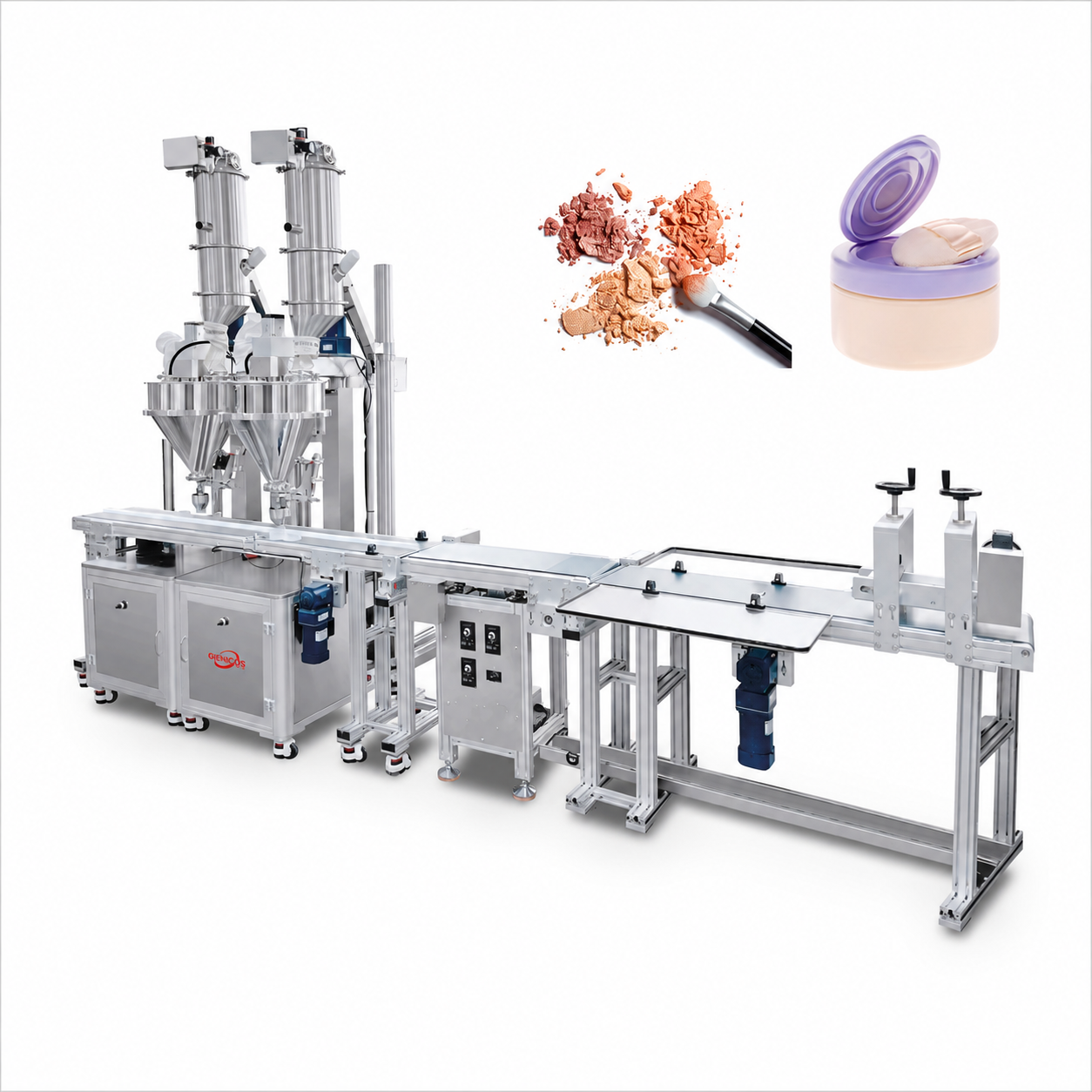
Robotic integration in a compact powder line is a handover decision, not a machine purchase. The Robot Compact Powder Assembly Line, model JZF, is a vision-guided robotic station from SHANGHAI GIENI INDUSTRY CO., LTD. (GIENICOS) that receives pressed godets from a compact powder press, inspects them with two visual detection sets, and seats them into conveyor-fed powder cases using one delta robot. Its published specification includes a rated capacity of up to 45 pcs, powder case sizes from 10 mm to 60 mm, a robot working diameter of 600 mm, a maximum robot load of 1 kg, and an approximate changeover/set time of 15 minutes.
This guide is written for the stage that follows supplier shortlisting and budget approval — the point at which a production team must decide where the robot physically sits inside an existing powder line, which press feeds it, what the sifter and mixer must deliver upstream, and how utilities, changeover and maintenance will behave over years of production rather than during one commissioning week.
It follows the whole powder chain that GIENICOS builds around that station — mixing, pulverizing, sifting, pressing, robotic assembly and labeling — because a robotic assembly station is only as stable as the four stages in front of it.
Problem Definition: Where a Compact Powder Line Actually Loses Time
In a conventional compact powder workshop, pressing and assembly are two separate islands. A press such as the JBC-4 or the GP 050 SE compresses powder into godets — typically several pans per mold — and those pressed godets are then carried to a table where operators drop each one into a powder case, close it, wipe the rim and stack the finished compact. Nothing in that description is technically difficult. The difficulty is that every single unit passes through a human decision.
Three failure patterns repeat in that layout:
- Seating variability. A godet that is not level, over-pressed or slightly out of tolerance may still be forced into the case by hand. The defect is sealed inside the finished compact and only surfaces at retail or in a customer complaint.
- Inspection inconsistency. Human visual checks of godet edges, surface cracking and case orientation change with shift, fatigue and lighting. Two operators on the same line will reject different units.
- Changeover drag. When a case size changes, the assembly table has to be re-set manually, and the downtime compounds at every downstream station.
Robotic assembly addresses the first two problems and compresses the third, but only inside a clearly defined scope. In the JZF configuration, the automated station covers powder case feeding by conveyor, vision-based inspection of the godet, vision-based inspection of the powder case, transfer by suction or pick & place, insertion, and discharge.
It does not compensate for upstream weakness. If a mixer delivers inconsistent bulk density, if a sifter passes agglomerates, or if a press produces variable fill weight, the robot will place a defective godet into a case faster and more consistently than a person would. That is why robotic integration has to be planned as a line decision — press, sifter and robot together — and why the specifications of each stage must be matched before the purchase order, not after installation.
Industry Background: Why Powder Automation Is Scaling Now
Fill and assembly automation is expanding inside a cosmetic equipment market that is itself growing. Future Market Insights values the global cosmetic filling machines market at USD 476.80 million in 2025 and projects USD 718.63 million by 2036, with automatic filling machines expected to hold a 41.2% share of cosmetic filling technology in 2026. Asia Pacific held a 33.08% share of the wider filling machine market in 2025, according to Fortune Business Insights.
Those figures describe the demand side. The operational change is on the supply side: compact powder buyers increasingly evaluate a line as a multi-year asset rather than a single machine. A factory that installs a press today will add a second SKU next year, a second shift the year after, and a labeling requirement the year after that. When mixing, sifting, pressing, assembly and labeling come from one supplier, expansion does not require re-engineering interfaces or re-validating three vendors' assumptions about container size, cycle time and cleanroom behaviour.
GIENICOS was founded in Shanghai in 2011 and manufactures cosmetic filling and packaging equipment together with robotic loading-unloading system solutions. The company reports a 2000 m² factory in the Baihao AI Technology Park, Jiading North Industrial Park, Jiading District, Shanghai, a R&D team of 10 engineers, an annual output of 100 units, an 80% export ratio, and main markets in the EU, USA and Asia. It states project partnerships with private-label and contract manufacturers such as COSMAX, INTERCOS, Weckerle, VIVA, OXYGEN, ICT and Fiabila, and with brand owners including L'Oréal, Winona and Chando. For a buyer planning a powder line over a five-year horizon, that installed base is a practical reference point: the same supplier already integrates powder preparation, pressing, robotic assembly and labeling for factories running multi-brand, multi-SKU production.
The Equipment Ecosystem Behind a Robotic Compact Powder Line
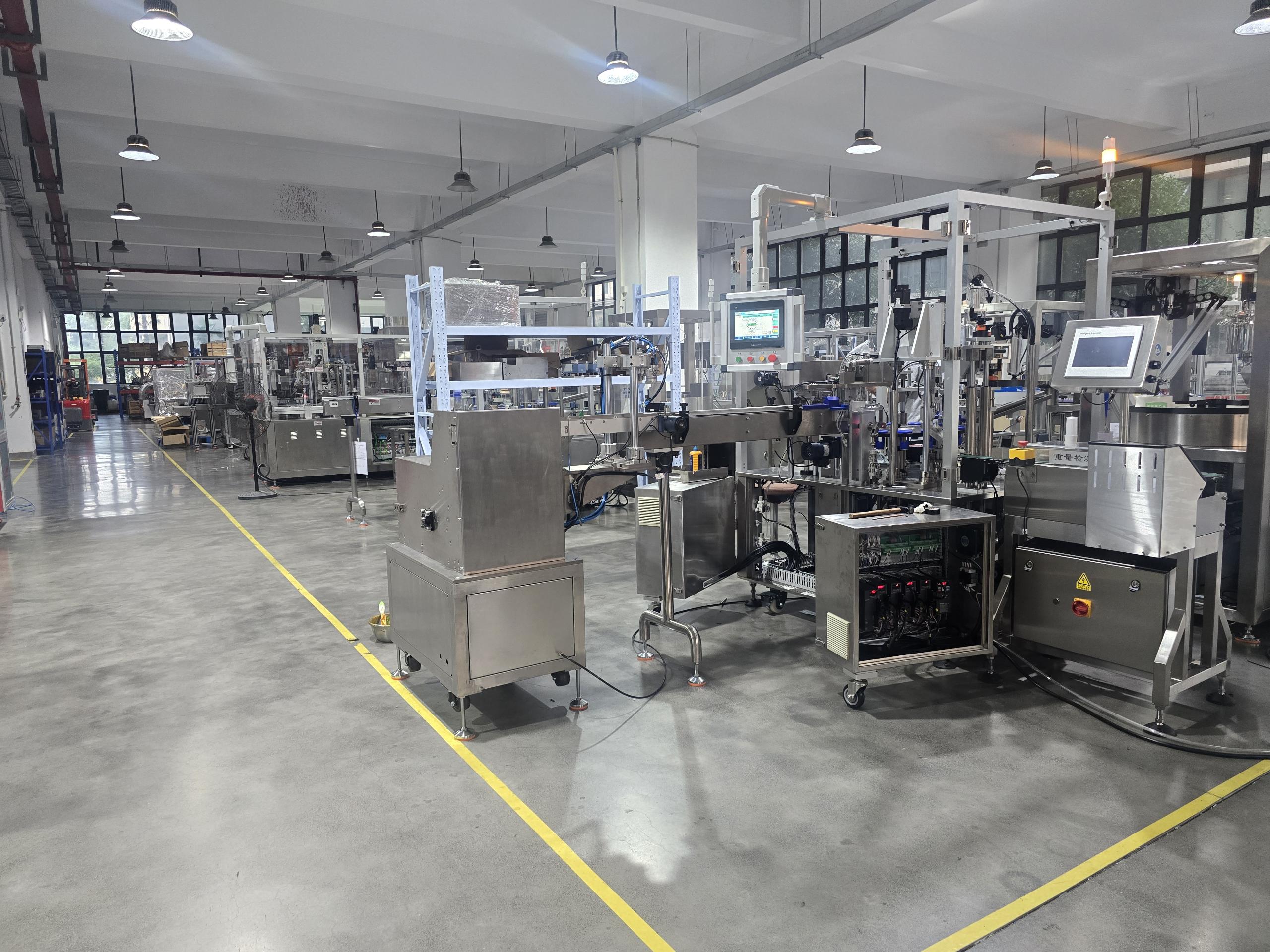
A robotic assembly station cannot be specified in isolation. The JZF depends on three upstream conditions: consistent bulk powder from the mixer, controlled particle size from the pulverizer and sifter, and stable godet dimensions from the press. GIENICOS supplies all of these stages, which is what makes a single-responsibility integration realistic.
1. Powder mixing — JY-CR50, JY-CR200, JY3-CR100
The mixing stage sets bulk density and colour uniformity, and both travel downstream into the pressed puck. The JY-CR50 is a 50 L high speed cosmetic powder mixer with a 10 kg per batch capacity, a 7.5 kW main motor running 0–2840 rpm, one side stirrer shaft at 2.2 kW and 2840 rpm, AC380V three-phase supply, a 1500 × 900 × 1500 mm footprint and 350 kg machine weight. The JY-CR200 scales that to a 200 L volume with 20–50 kg per batch, a 37 kW main motor at 0–2840 rpm and three side stirrer shafts, weighing 1500 kg. The JY3-CR100 sits between them with 100 L, 10–25 kg capacity, an 18.5 kW main motor, three side shafts and 1200 kg weight.
2. Particle control — JMP08 pulverizer and PSF vibration sifter
Before powder reaches the press, two machines decide whether the puck will hold together. The JMP08 powder pulverizer runs a 7.5 kW motor at 7200 rpm with screw feeding and adjustable feed speed, a capacity of 20–50 kg per hour, eight hammers and interchangeable sieve sizes of 1.0, 1.5 and 2.0 mm. The PSF vibration powder sifter then removes oversize material through a 440 mm screen at 40 or 60 mesh, drawing 0.75 kW from an AC380V or 220V three-phase supply, with a 470 × 744 × 1042 mm footprint and 45 kg weight.
Integration note: sifter mesh is the last opportunity to intercept agglomerates before pressing. A robotic assembly station with vision inspection will detect some surface defects on the godet, but it cannot detect the density variation caused by unsifted lumps. Match the sifter mesh to the powder formulation before specifying the robot, not after.
3. Pressing — JTC, JBC-4, JBC-5 and GP 050 SE
The press defines the godet geometry, and therefore the tolerance window the robot has to work within. GIENICOS builds four compact powder press configurations:
- JTC — hydraulic up-bottom compact powder press, full hydraulic drive, working pressure 0.1–14 MPa, maximum hydraulic output pressure 8 tons, 800 mm table height, AC380V three-phase, 1465 × 570 × 1670 mm, 400 kg, built from 304 stainless steel and 6061 aluminium components.
- JBC-4 — bottom-up hydraulic compact powder press, full hydraulic drive, 2–3 molds per minute with a typical production capacity of 720–1080 pcs per hour, up to 6 pans per mold depending on aluminium pan size, working pressure 0.4–0.6 MPa, maximum hydraulic output pressure 15 tons, 4.5 kW, 1–2 operators.
- JBC-5 — servo-hydraulic bottom-up press, maximum pressure 14 tons, maximum 3 molds per minute with a typical mold capacity of 9 pcs at approximately Ø50 mm, 380V three-phase, 1–2 operators, 1700 × 1500 × 1800 mm, 650 kg.
- GP 050 SE — fully automatic rotary servo powder press, rated 50–60 pcs per minute with 4 cavities as an example, single colour with customisation available, 0.5–1 operator, and a ROBOT pan feeder listed as an option. Applications are compact powder and eyeshadow.
4. Robotic assembly — the JZF Robot Compact Powder Assembly Line
This is the stage the rest of the line has to feed. The published specification of the JZF vision-guided robotic compact powder assembly line is as follows:
- Capacity: up to 45 pcs
- Delta robot: 1 unit; robot working diameter 600 mm; maximum robot load 1 kg
- Visual detection: 2 sets — one for the godet, one for the powder case
- Powder case size range: 10–60 mm, fed by conveyor
- Visual feeding method: suction or pick & place
- Changeover / set time: approximately 15 minutes
- Machine size: 700 × 1100 × 1800 mm
- Power supply: single phase 220V, 60Hz, 2 kW
- Air supply: 0.5–6 MPa, 300 L/min
The two vision sets are the part buyers most often underestimate. One inspects the godet before transfer, which is where cracked edges, short fills and surface faults are rejected before they are sealed inside a case. The second inspects the powder case, which is where orientation, presence and gross deformation are caught. What the system verifies is position, presence and visible condition — it does not measure fill weight or bulk density, because those are set by the mixer, sifter and press.
Two specification details deserve attention during engineering review. First, the published power supply is single phase 220V at 60Hz, 2 kW: for 50Hz markets the electrical configuration should be confirmed at quotation. Second, the robot's 1 kg maximum load and 600 mm working diameter define the practical envelope for case geometry and transfer distance — unusual oversized or heavily weighted cases should be checked against that limit before layout is frozen.
5. Downstream labeling and adjacent powder formats
Once the compact is assembled, the JTB-812 powder case top and bottom labeling machine closes the loop with 50–80 pcs per minute, ±1 mm labeling accuracy, a 30–100 mm container diameter range, 220V ±10% power supply and a 2000 × 810 × 1600 mm footprint. For factories that also run loose powder formats on the same site, GIENICOS supplies the JLF rotary loose powder filling machine and the JLF-A dual-nozzle linear loose powder filling machine — the JLF-A uses SUS316L product-contact parts, a Mitsubishi PLC, a Panasonic servo motor and a JSCC conveying motor, with 30–40 pcs per minute capacity and a 25 L hopper. Sharing one supplier across compact and loose powder lines reduces the number of separate service relationships a factory has to manage.
Step-by-Step: Integrating the Robot Station With Your Presses and Sifters
Step 1 — Match press output to robot capacity
The robot must have headroom over the press, never the reverse. Working from published figures: the JBC-4 runs 2–3 molds per minute at a typical 720–1080 pcs per hour; the JBC-5 runs up to 3 molds per minute with a typical 9 pcs per mold, which is roughly 27 pcs per minute when both stated figures are combined; the GP 050 SE runs 50–60 pcs per minute with 4 cavities as an example. The JZF is rated at up to 45 pcs. Confirm the unit basis and the cycle time of your specific press configuration with the supplier before signing, because a press running at its maximum rate against an assembly station with no margin converts the robot into the new bottleneck.
Step 2 — Fix the physical handover
The JZF receives powder cases by conveyor and works within a 600 mm robot diameter, with a machine footprint of 700 × 1100 × 1800 mm. In practice this means the press discharge and the assembly infeed should be positioned so that pressed godets travel the shortest possible distance without manual handling — the shorter that path, the fewer chances for a godet to be chipped or dropped between stages. Reserve the changeover area next to the station, not across the aisle.
Step 3 — Configure vision against real defect types
Before commissioning, list the defects your current line actually produces — cracked rims, short fills, surface pinholes, wrong case orientation, colour mismatch between compact and case. The JZF's two visual detection sets, one for the godet and one for the powder case, should be configured against that list. Vision is a filter with a defined job; it is not a substitute for a stable press.
Step 4 — Plan changeover around the 15-minute set time
The published changeover/set time for the JZF is approximately 15 minutes. That figure only holds if change parts for each powder case size are prepared in advance and stored with the recipe. Build a changeover kit per case family — godet handling tooling, case guides and saved parameters — and treat the 15 minutes as the target for the assembly station alone. Press mold changes are a separate operation and should be scheduled in parallel, not sequentially.
Step 5 — Confirm utilities and cleanroom compatibility
The assembly station needs single phase 220V at 2 kW and an air supply of 0.5–6 MPa at 300 L/min. The presses and mixers upstream need three-phase 380V — 4.5 kW on the JBC-4, and up to 37 kW on the JY-CR200 mixer. GIENICOS equipment is developed specifically for colour cosmetics and skincare products and is designed to fit cosmetic GMP clean-room workshops; the assemblies use a modular structural design that supports fast disassembly, convenient cleaning and spare-part replacement. Powder equipment in a cleanroom is judged on how quickly it can be opened and cleaned between batches, so verify access routes and cleaning paths at the layout stage, not during FAT.
Step 6 — Validate with the acceptance method agreed in the contract
The standard acceptance route for GIENICOS equipment is factory acceptance testing on site, or video inspection before shipment, using production-representative powder, godets and cases. Run the line at the intended rate long enough to expose thermal drift on the press and any vision false-reject pattern on the robot station.
Production Profiles: Three Ways This Line Is Configured
Profile 1 — High-volume single-format compact production
A brand-owned base running one dominant compact format at volume pairs the GP 050 SE rotary servo press (50–60 pcs per minute, 4 cavities as an example, 0.5–1 operator) with the JZF assembly station and the JTB-812 top-and-bottom labeler. The GP 050 SE also lists a ROBOT pan feeder option, which removes the remaining manual pan handling step at the press. This profile tolerates infrequent changeover and prioritises steady-state throughput.
Profile 2 — Multi-SKU contract manufacturing
A private-label or contract manufacturer running many small batches needs the opposite trade-off: flexible formats and short set-up. Here the JBC-5 servo-hydraulic bottom-up press (up to 3 molds per minute, typical 9 pcs per mold at approximately Ø50 mm, 1–2 operators) or the JBC-4 (720–1080 pcs per hour, up to 6 pans per mold) feeds the JZF, and the value of the robot's approximately 15-minute changeover/set time becomes the deciding factor. This is the profile GIENICOS describes as its key-account focus: customised development based on the customer's packaging, formula characteristics and workshop conditions, rather than standard mass-produced universal machines.
Profile 3 — Compact and eyeshadow on one press
The GP 050 SE lists compact powder and eyeshadow as its applications, with one colour as standard and customisation available. Factories producing both categories from a single press schedule should plan robot changeover around the case geometry difference between the two, since the JZF handles case sizes across a 10–60 mm range and the set time is dominated by tooling and parameter changes, not by the robot program itself.
Comparison Table: Compact Powder Press Options
| Model | Pressing type | Drive system | Max. hydraulic output pressure | Stated output | Mold / pan capacity | Operators |
|---|---|---|---|---|---|---|
| JTC | Up bottom press | Full hydraulic | 8 tons (working pressure 0.1–14 MPa) | — | — | — |
| JBC-4 | Bottom up press | Full hydraulic | 15 tons | 2–3 molds/min; 720–1080 pcs/hour | Up to 6 pans/mold | 1–2 |
| JBC-5 | Bottom up pressing | Servo motor hydraulic | 14 tons | Max. 3 molds/min | Typical 9 pcs/mold at approx. Ø50 mm | 1–2 |
| GP 050 SE | Servo type rotary (hydraulic press optional) | Rotary, fully automatic | — | 50–60 pcs/min (4 cavities as example) | 4 cavities as example | 0.5–1 |
— indicates that the figure is not stated in the published model specification and should be confirmed at quotation. All figures above are taken from the GIENICOS model specifications.
Comparison Table: Powder Preparation Equipment
| Model | Function | Volume / capacity | Drive and electrical data | Notes |
|---|---|---|---|---|
| JY-CR50 | High speed powder mixer | 50 L; 10 kg/batch | 7.5 kW main at 0–2840 rpm; 2.2 kW side; AC380V 3-phase | One side stirrer shaft; 1500 × 900 × 1500 mm; 350 kg |
| JY-CR200 | High speed powder mixer | 200 L; 20–50 kg/batch | 37 kW main at 0–2840 rpm; 2.2 kW side; AC380V 3-phase | Three side stirrer shafts; 2400 × 2200 × 1980 mm; 1500 kg |
| JY3-CR100 | High speed powder mixer | 100 L; 10–25 kg | 18.5 kW main at 0–2840 rpm; 2.2 kW side; AC380V 3P | Three side stirrer shafts; 1900 × 1400 × 1600 mm; 1200 kg |
| JMP08 | Powder pulverizer | 20–50 kg/hour | 7.5 kW; 7200 rpm; screw feeding, adjustable speed | 8 hammers; sieve 1.0 / 1.5 / 2.0 mm |
| PSF | Vibration powder sifter | 440 mm screen diameter; 40 / 60 mesh | 0.75 kW; AC380V / 220V 3-phase | 470 × 744 × 1042 mm; 45 kg |
Designing for the Long Run: Changeover, Maintenance and Support
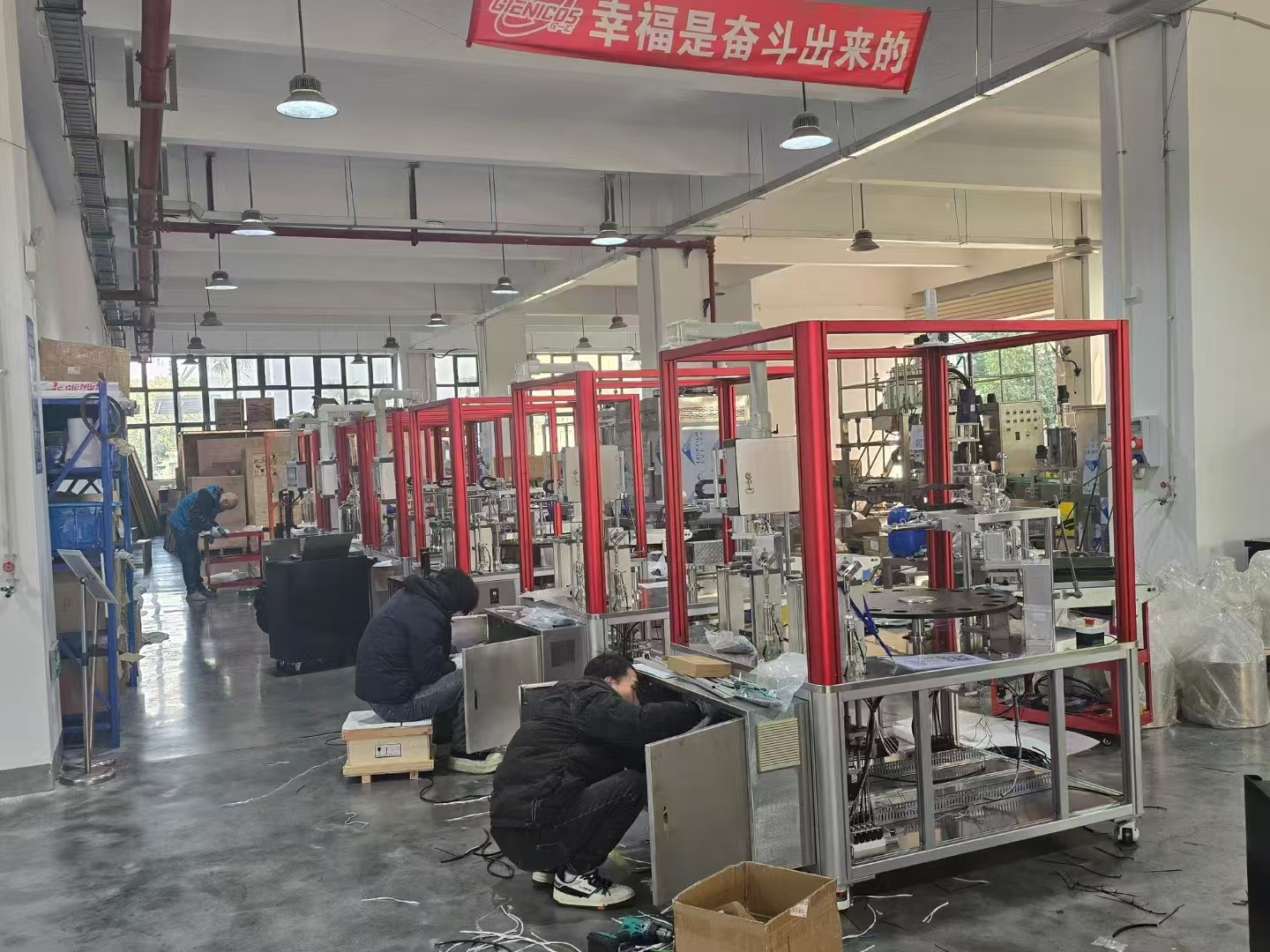
Because a powder line is bought for years rather than quarters, the maintenance model matters as much as the cycle time. GIENICOS equipment uses a modular structural design so that key assemblies can be disassembled quickly for cleaning and spare-part replacement, which is what keeps unplanned downtime short in a cleanroom environment where every stoppage also carries a cleaning cost.
Two design positions shape the long-run economics. First, material and component selection: GIENICOS states that product-contact parts that come into contact with cosmetic bulk are built in SUS316L where the application requires it — as on the JLF-A loose powder filling machine, which uses SUS316L product-contact parts — while compact powder presses such as the JTC and JBC-4 use 304 stainless steel and 6061 aluminium components. Second, critical components are sourced from suppliers such as Mitsubishi and Schneider; the JLF-A, for example, uses a Mitsubishi PLC and a Panasonic servo motor. The company positions this against a stated cost difference of approximately 10–20% higher than typical Guangdong-based cosmetic machine suppliers, and links the difference to component sourcing, product-contact materials and a key-account focus on customised development rather than standard mass production. Buyers should weigh that premium against their own downtime cost per hour — that is the only comparison that resolves the question honestly.
The same logic applies to the robot station. A 15-minute changeover and a modular assembly are useful only if change parts, vision parameters and cleaning procedures are documented and stored with the machine. Ask for that documentation as part of the delivery package, not as an afterthought.
Frequently Asked Questions
Which safety and electrical standards does GIENICOS powder processing equipment meet?
The JY-CR50 and JY-CR200 High Speed Powder Mixers meet the requirements of EN 60204-1:2018 and EN ISO 12100:2010. GIENICOS states that its product range, which includes machines for mascara, lipgloss, eyeliner, CC cream and high-speed filling production lines, carries CE certification. For customs and trade classification, cosmetic filling machinery falls under HS Code 8422.30, specifically 8422.30.91 for machinery used in opening, filling and closing containers.
What powder case sizes can the Robot Compact Powder Assembly Line handle, and how long does a changeover take?
The JZF Robot Compact Powder Assembly Line accepts powder case sizes from 10 mm to 60 mm, fed by conveyor, and its published changeover/set time is approximately 15 minutes. It uses one delta robot with a 600 mm working diameter and a maximum load of 1 kg, and two visual detection sets — one for the godet and one for the powder case. Cases are transferred by suction or pick & place, and the station is rated at up to 45 pcs.
What are the purchasing terms, and how is this equipment priced?
The stated purchasing terms are: MOQ 1 unit; delivery terms FOB, CNF, CIF or DDP; payment terms T/T 40%/60%; and acceptance criteria of factory acceptance testing on site or video inspection before shipment. On pricing, GIENICOS positions its equipment at approximately 10–20% higher cost than typical Guangdong-based cosmetic machine suppliers and attributes the gap to product-contact material selection, internationally sourced critical components and customised development for key-account clients rather than standard mass production.
Can we validate the line before shipment?
Yes. The standard acceptance route is FAT on site or video inspection before shipment, which can be run with production-representative powder, godets and powder cases. Because GIENICOS focuses on customised solutions — adapting to different packaging and production requirements through modular machine design — container geometry, case size and cleaning procedure should be confirmed during this validation stage so that the delivered configuration matches the workshop conditions.
What warranty and after-sales support apply over the life of the line?
The standard warranty is 12 months from the date of machine acceptance. It covers manufacturing defects, excluding wearing consumable parts and man-made damage, with free spares and freight carried by GIENICOS. Maintenance is supported by a modular structural design in which key assemblies can be disassembled quickly for cleaning and spare-part replacement, and by remote technical support. To review the full powder and assembly equipment range before planning the integration, download the 2026 GIENICOS catalogue, or send your case size, press model and target output to sales@genie-mail.net.
Conclusion: Match the Robot to the Press, Then to the Years Ahead
A robotic compact powder assembly line succeeds or fails at the interfaces. Inside the JZF station, one delta robot with two vision sets handles godet inspection, case inspection and insertion, with a changeover/set time of approximately 15 minutes across a 10–60 mm case range. Around it, the mixer, pulverizer, sifter and press decide whether the godet arriving at that station is worth placing at all.
That is why this integration should be specified as one chain: mixing on the JY-CR50, JY-CR200 or JY3-CR100; particle control on the JMP08 and PSF; pressing on the JTC, JBC-4, JBC-5 or GP 050 SE; robotic assembly on the JZF; and labeling on the JTB-812. Specify the interfaces — output rate, case geometry, utilities, cleanroom access — and the station becomes an expansion point rather than a constraint when the next SKU or the next shift arrives.
Next Step
Send your compact powder case dimensions, press model and target output to the GIENICOS engineering team. You will receive an integration layout showing where the robotic assembly station sits relative to your press and sifter, together with the utility and changeover requirements for your specific configuration.
Email: sales@genie-mail.net | Tel / WhatsApp: +86 134 8206 0127
Website: www.gienicos.com
Catalogue: Download the 2026 GIENICOS equipment catalogue (PDF)
Factory address: FL1-2, Building 3, No.1277 Xingwen Road, Baihao AI Technology Park, Jiading North Industrial Park, Jiading District, Shanghai.
Have Questions or Need More Details?
Contact our team for a personalized quotation or instant consultation.
Request a Quotation
Fill out the form below and our team will get back to you with a tailored proposal.
WhatsApp Direct Chat
Prefer to chat in real-time? Message us on WhatsApp for instant assistance & quick answers.
- Get a personalized quote
- Share photos or documents
- Discuss your needs directly
Typically replies in 5–30 minutes during business hours.