
Servo Piston vs. Peristaltic Filling Heads: A Technical Guide to Cosmetic Filling Precision
Servo Piston vs. Peristaltic Filling Heads: A Technical Guide to Cosmetic Filling Precision
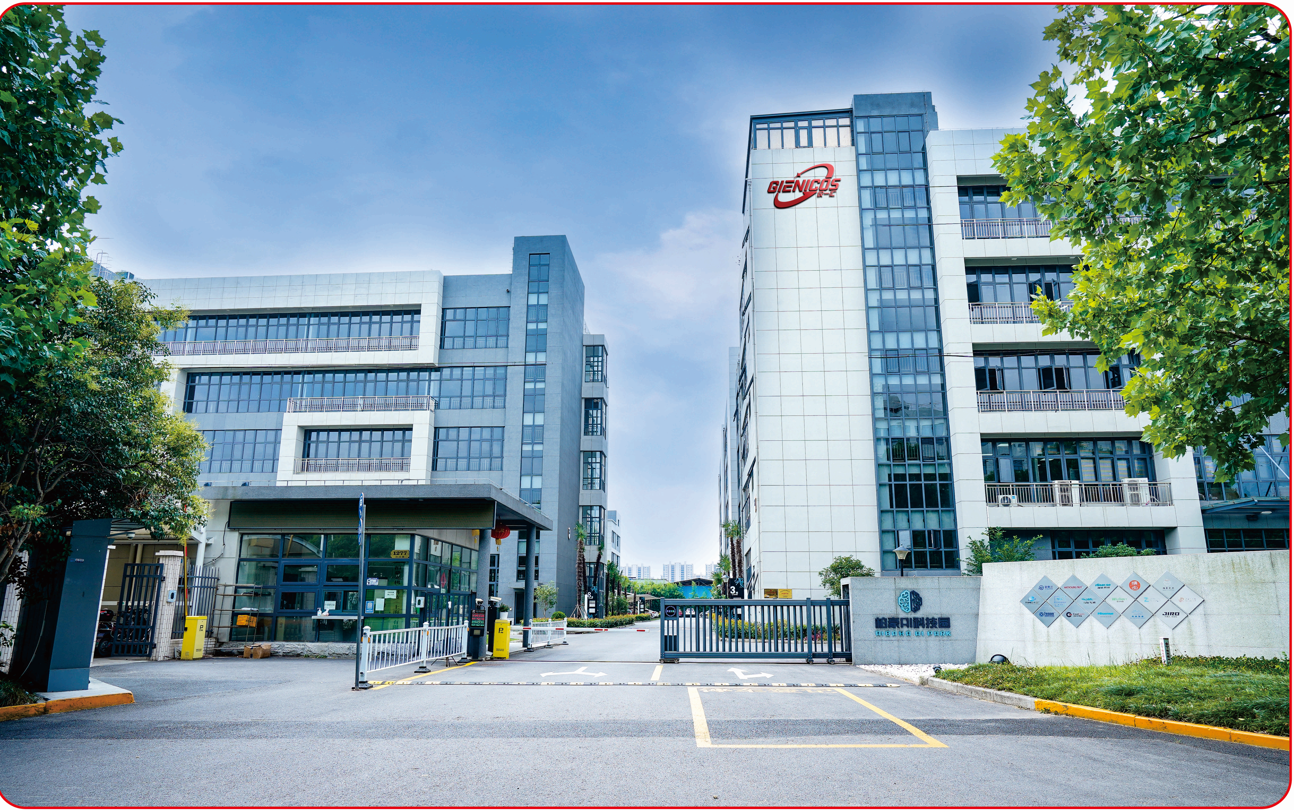
GIENICOS builds cosmetic filling and packaging equipment in Shanghai, including servo piston filling heads and rotary peristaltic filling configurations.
Filling precision on a cosmetic line is decided by the filling head, not by the brand of the surrounding conveyor. Two heads can both be quoted as “high precision”, both carry CE documentation, and both cost roughly the same — yet on the same lip gloss bulk one holds net content comfortably through a full shift while the other drifts as the shift progresses.
For engineers evaluating a cosmetic filling machine, the working rule is this: a servo piston filling head meters volume through a servo-controlled piston stroke, which makes it the standard architecture for viscous, hot-filled or emulsified products where a tight net-content tolerance must hold across a production run. A peristaltic filling head meters volume by compressing a flexible tube, which makes it the standard architecture for low-viscosity, shear-sensitive or colour-critical liquids such as liquid eyeliner, where the product never enters the pump body and contacts only the tube interior.
This guide dissects the operating principles behind both architectures, the published parameters that separate them in practice, the cleaning and compliance questions that must be closed before purchase, and a requirement-fit shortlist drawn from the GIENICOS filling portfolio. GIENICOS is the brand of SHANGHAI GIENI INDUSTRY CO., LTD., a Shanghai-based manufacturer founded in 2011 that builds intelligent cosmetic filling and packaging equipment for makeup and skin care production.
Direct answer: choose servo piston when the formula is viscous, hot-filled or emulsion-based and the tolerance budget is tight; choose peristaltic when the formula is a low-viscosity liquid where shear, colour carry-over or cleaning segregation matters more than absolute volumetric rigidity. The two are not competing tiers of the same product — they are different metering physics.
Problem Definition: Why Precision Claims Are Not Comparable Between Two Filling Heads
The evaluation problem for a filling head is not “which is more accurate”. It is “which error source dominates my formula, my container and my tolerance budget”. A piston head and a peristaltic head fail in different ways, and the failure modes are visible only under production conditions.
In a servo piston head, dispensed volume is set by the stroke of a piston inside a metering cylinder. Accuracy therefore depends on the mechanical repeatability of the servo stroke and on how cleanly the cylinder refills. The dominant error sources in service are seal wear, entrained air in the bulk material, and the density change that occurs when a hot-filled wax or cream cools after dosing. Because the piston displaces a fixed geometric volume, viscosity changes shift fill weight only indirectly, through refill behaviour and residual product on the nozzle.
In a peristaltic head, dispensed volume is set by the number of roller passes compressing a flexible tube, so the tube itself is the metering element. The dominant error sources are tube ageing and elastic drift, pulsation in the flow path, and sensitivity to downstream back-pressure. The offsetting advantage is segregation: because fluid touches only the tube, cleaning between colour batches is a tube-change operation rather than a full wetted-path flush.
Why published tolerances must be read carefully: GIENICOS publishes ±0.15 g for the JQL-04C BB/CC cushion filling machine and ±0.15 g for the JQL-02N nail polish filling machine, and in both cases the figure is explicitly qualified as “subject to material formula” and, for the cushion machine, sponge characteristics and other factors. A tolerance figure without a stated test condition is a marketing number; a tolerance figure with a stated condition is an engineering input.
The practical consequence is that a tolerance budget on a cosmetic line is rarely a filling-head number alone. It is the sum of filling repeatability, container tare variation, product density variation between batches, and residue left at the bottle mouth. A return-suction anti-drip nozzle, such as the one specified on the JMG lipgloss and mascara filling line, attacks the last of those variables directly by reducing bottle-mouth contamination rather than by improving the pump.
Industry Background: Why Cosmetic Filling Machine Selection Is Moving Toward Verified Parameters
Cosmetic filling equipment is a specialised segment inside the wider packaging machinery category, and its growth is being driven by automation rather than by mechanical replacement alone. Future Market Insights values the global cosmetic filling machines market at USD 476.80 million in 2025 and projects it to reach USD 718.63 million by 2036. Within that market, FMI projects automatic filling machines to hold a 41.2% share of the cosmetic filling technology market in 2026 — a signal that buyers are increasingly specifying automated metering and capping rather than semi-automatic stations.
Regional supply is concentrated as well. Fortune Business Insights reports that Asia Pacific dominated the filling machine market with a 33.08% share in 2025, which is consistent with the density of contract manufacturing capacity across the region. Sub-segment projections point the same direction: Strategic Revenue Insights projects the automatic lipstick filling machines market to reach approximately USD 1.2 billion by 2033, expanding at a 5.8% CAGR from 2025. As a category, equipment shipped across borders also carries a trade classification: cosmetic filling machines fall under HS Code 8422.30, specifically 8422.30.91 for machinery used in opening, filling and closing containers.
For an engineer, the practical implication of this environment is that filling-head comparisons now happen against a rising baseline of automated equipment. That makes the distinction between metering principles — and the documentation that proves it — more decision-relevant than the number of stations on a brochure.
How Each Filling Head Actually Meters Product
Servo piston filling: volume defined by stroke
A servo piston filling head draws product into a metering cylinder on the upstroke and discharges it on the downstroke. The servo motor controls stroke length and speed independently, which is why the same head can be tuned for a low-viscosity lotion and a thick lip cream without changing the pump body. GIENICOS builds this architecture across a wide model range, and the published parameters show how the same principle is scaled from single-nozzle hot filling to a 100 pcs/min linear line.
- JSFL 1-2 Servo Piston Filling Machine — single or dual nozzle servo piston filling, with a liftable tank, specified for lip balm, lipstick, lip cream and high-viscosity cosmetic products in cosmetic hot filling and high-viscosity filling duty.
- JYF-4 Multi-color Hot Filling Machine — a four-in-one single-nozzle multi-colour hot filling line using servo piston filling control, with a 20 L effective tank, SUS316L product-contact material, filling ranges of 2–20 mL, 20–50 mL and 50–100 mL, and published filling precision of ±0.1 g on AC220V single phase.
- JQH-02 Automatic Lipgloss Filling and Capping Machine — servo piston filling across 1–20 mL at 60–80 pcs/min with ±0.1 g precision, drawing 13 kW on three-phase 380V.
- JQR-01A Automatic Mascara Filling and Capping Machine — 2–14 mL filling range at 40–45 PPM with ±0.1 g precision, handling containers from 10 mm to 125 mm in diameter and 40–90 mm in length excluding the cap.
- JRS-G3 Automatic Toner & Cream Rotary Filling Machine — servo piston filling from 10–300 mL, at ±0.5 g for 20–100 mL and ±0.5% for 101–300 mL, with a documented 15-minute changeover time.
- GLU-1300 Automatic Silicone Mold Lipstick Filling Machine — a servo-driven piston pump with two nozzles, a 30 L electrically oil-heated tank, a 112-piece silicone mold and two LEISTER hot air guns, producing 1,000–1,300 pcs/hour for lipstick diameters of approximately 8–17.1 mm.
- JMG Linear High Speed Lipgloss Mascara Filling Line — servo piston filling at 10–12 pcs per cycle, mid-speed 60–72 pcs/min and high-speed 80–100 pcs/min, with static or fall-while-filling options, SUS316L wetted parts, GMP-compliant construction, servo torque capping with adjustable torque and speed, and no-bottle no-fill detection.
Peristaltic filling: volume defined by tube deformation
A peristaltic head uses rollers to compress a flexible tube progressively, pushing a discrete slug of liquid forward with each pass. Because there is no valve, no piston seal and no internal dead volume, the architecture suits liquids that are abrasive to seals, prone to shear damage, or that must be kept separate between batches. GIENICOS specifies this principle on the JR-02E Eyeliner Filling Machine, a rotary liquid eyeliner filling machine that fills two products per cycle at 30–40 pcs/min using peristaltic pump filling, with a machine footprint of 1,800 × 1,745 × 2,095 mm on AC220V single phase and a stated air consumption of ≥900 L/min at 0.6–0.8 MPa.
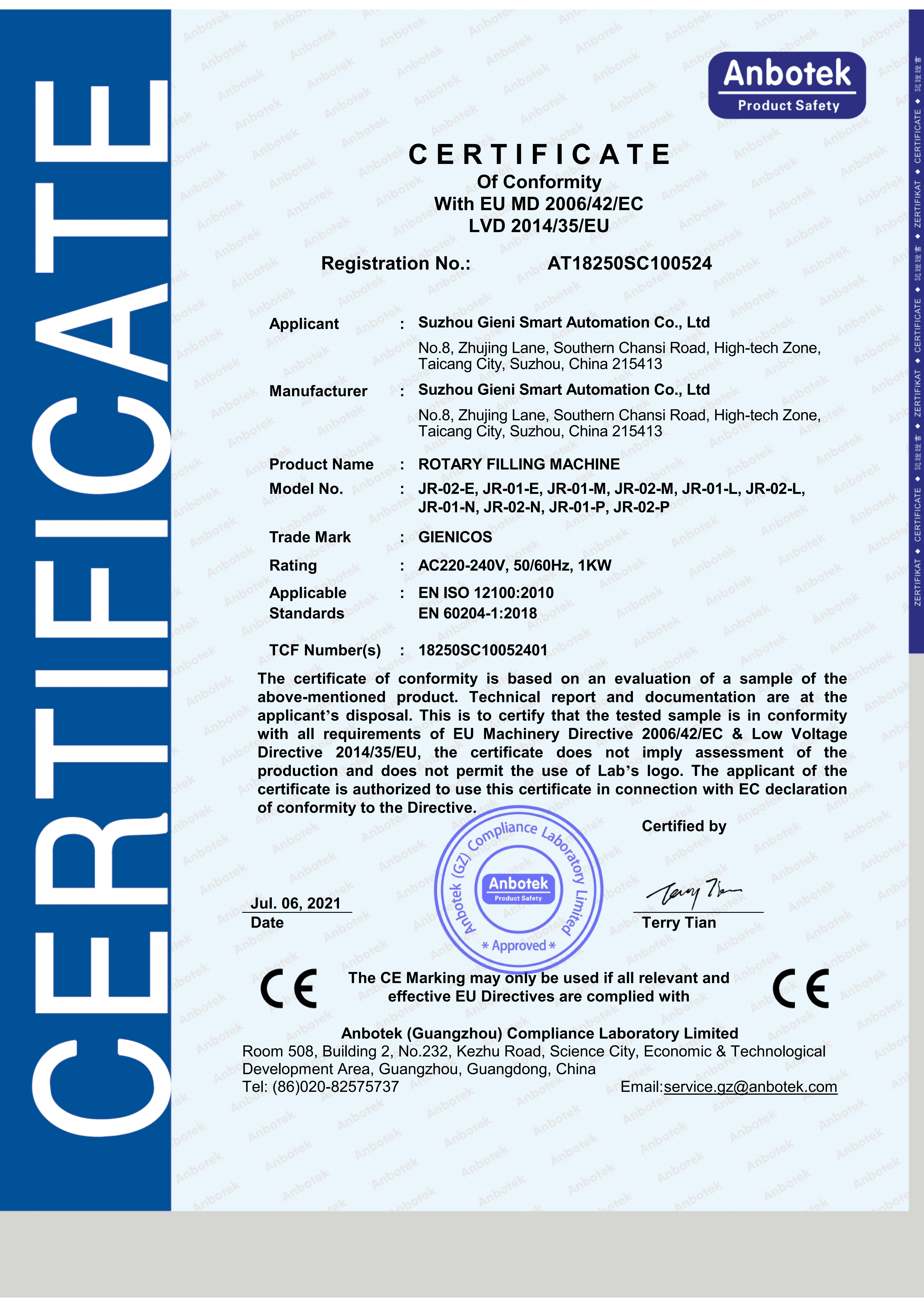
CE certificate AT18250SC100524, issued by Anbotek (Guangzhou) Compliance Laboratory Limited, covers the GIENICOS rotary filling machine series JR-01-E, JR-02-E, JR-01-M, JR-02-M, JR-01-L, JR-02-L, JR-01-N, JR-02-N, JR-01-P and JR-02-P.
What the published parameters tell an engineer
Across the GIENICOS servo piston range, the published fill tolerance is consistently ±0.1 g on the models where a figure is stated: JYF-4, JQH-02, JQR-01A, JR-02M/L, JR-01P and the JLG-10/12 semi-automatic lipstick filling series. Larger-volume rotary equipment widens the figure in step with volume — the JRS-G3 states ±0.5 g between 20 and 100 mL and ±0.5% between 101 and 300 mL. For the peristaltic JR-02E, the available parameter set publishes throughput and machine geometry but no fill-tolerance figure, which is itself a useful signal: when a tolerance is not published for a model, the buyer should ask for a validated test report on their own formula before treating the head as tolerance-critical.
Step-by-Step Breakdown: Evaluating a Filling Head for a Specific Formula
The following sequence converts a filling-head discussion into a decision. It is ordered so that each step either confirms or eliminates an architecture before expensive work begins.
- Characterise the formula before the machine. Record viscosity at filling temperature, whether the product is hot-filled and cooled afterwards, and whether it contains particles, waxes or pigments that shear badly. The JRS-G2 dual-nozzle servo toner and cream filling machine publishes a material viscosity limit of ≤15,000 mPa.s at normal pressure, which is the kind of stated boundary that should be compared against a measured viscosity curve, not a room-temperature figure.
- Define the tolerance budget, then split it. Decide the net-content tolerance at the container, then allocate the share available to the filling head after container tare and density variation are deducted. A ±0.1 g head inside a ±0.3 g budget leaves room for batch variation; the same head inside a ±0.12 g budget does not.
- Match the metering principle to the rheology. Hot-filled wax-based bulk, lip balm, lipstick and thick creams point to servo piston filling with heating — for example the JHF Hot Filling & Cooling Line, which covers 1–20 mL, 20–50 mL, 50–100 mL and 100–200 mL ranges with 2, 4, 6 or 16 nozzles and up to 60 pcs/min at six nozzles. Low-viscosity, seal-sensitive liquids point to peristaltic metering.
- Check container geometry against the feeding system. Published envelopes matter: the JQR-01A accepts container diameters of 10–125 mm and lengths of 40–90 mm excluding cap; the JLG-10H trial sample filling machine accepts 12–20 mm bottles; the GFS-40/60 tube filling and sealing machine accepts 10–50 mm tube diameters and 60–210 mm tube lengths. A head that meets tolerance but cannot accept the container is not a solution.
- Model the cleaning and changeover route. GIENICOS adopts a modular structural design in which key assemblies support fast disassembly, cleaning and spare-part replacement. For a piston head, cleaning time is a scheduled quantity: the JMF vertical dual nozzle filling machine publishes a cleaning time of approximately 30 minutes. For a peristaltic head, the changeover is dominated by tube replacement, so tube availability and replacement interval should be part of the commercial evaluation.
- Confirm the compliance scope names your exact model. A CE file that covers a line does not automatically cover a variant. Verify that the certificate scope lists the model on the quotation, and that the declared standards match the machinery directive route being applied.
- Validate on your own formula before committing the line. Run a pilot fill with your bulk, your container and your target tolerance, then confirm the acceptance criteria in writing against the machine's 100% OQC test before shipping.

CE certificate AT58250SC000523, issued by Shenzhen Anbotek Compliance Laboratory Limited on 31 July 2020, covers the Single Nozzle Hot Filling Line, model series JSFL — the servo piston hot filling architecture discussed in this guide.
Use Cases: Which Head Fits Which Cosmetic Format
Hot-filled wax and stick formats
Lip balm, lipstick and stick deodorant bulk must be dosed above its congeal point and cooled in the mold or container. This is servo piston territory, with heated tanks and downstream cooling. The JHF hot filling and cooling line pairs the filling head with a cooling module, an MT melting tank and a JCT cooling machine inside a single CE-certified scope, and the GLU-1300 combines a servo-driven piston pump with a 112-piece silicone mold and two LEISTER hot air guns for lipstick output of 1,000–1,300 pcs/hour.
High-speed lipgloss, mascara and lip oil
These are medium-viscosity, often pigmented liquids where throughput and bottle-mouth cleanliness decide yield. The JMG line combines servo piston filling at 10–12 pcs per cycle with a return-suction anti-drip nozzle, no-bottle no-fill detection and servo torque capping, running at 60–72 pcs/min mid-speed or 80–100 pcs/min high-speed. This is also the configuration most often specified as the backbone of an automatic cosmetic filling line for OEM and ODM factories.
Liquid eyeliner and low-viscosity colour cosmetics
Liquid eyeliner pencil production is the clearest peristaltic use case in the GIENICOS range: the JR-02E fills two products per cycle at 30–40 pcs/min using peristaltic pump filling, and the rotary architecture keeps changeover between colour batches contained to the tube path.
Cream, lotion, serum and foundation
Emulsion products need a head that tolerates viscosity without aerating the bulk. The JRS-G3 automatic toner and cream rotary filling machine covers oil, toner, serum and cream from 10–300 mL at up to 50 pcs/min with servo piston metering and a 15-minute changeover; the JRS-G2 dual-nozzle unit handles 10–300 mL at 45 bottles/min for a 50 mL fill where material viscosity stays ≤15,000 mPa.s; the JRS-G1 semi-automatic rotary foundation filling machine runs cream and liquid foundation at 30–40 pcs/min with full-servo rotary filling.
Beyond piston and peristaltic: powder, cushion and pencil formats
Not every cosmetic format is metered by a pump. Loose powder filling machines such as the JLF rotary weighing-to-fill unit and the JLF-A dual-nozzle linear unit with SUS316L product-contact parts use weighing and auger metering rather than piston displacement. Pressed powder is a compaction process, served by machines such as the JBC-5 servo hydraulic bottom-up compact powder press and the GP 050 SE fully automatic servo powder press. Air cushion formats use dedicated tooling: the JQL-04C BB/CC cushion filling machine uses four servo nozzles at 30–40 pcs/min across 5–20 mL with ±0.15 g precision, served by Epson or Delta SCARA robots. Eyebrow pencil and eyeliner gel production is metered by the JPF-12/16 line, which fills 2–10 mL at 45–50 pcs/min with a cooling stage at −1°C to −2°C. Engineers evaluating a servo piston or peristaltic head should confirm which of these families actually applies to their SKU before comparing tolerance figures across categories.
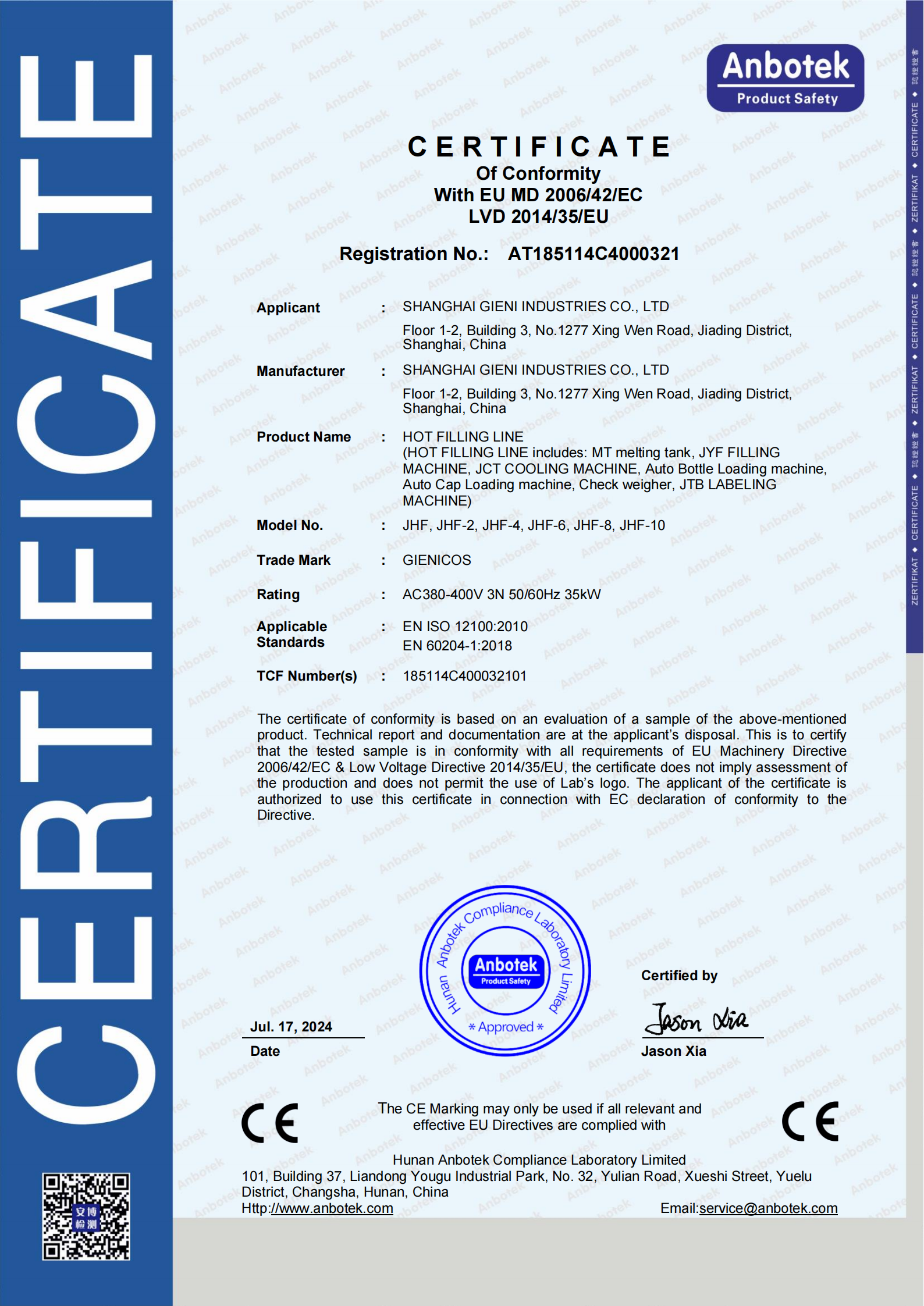
CE certificate AT185114C4000321, issued by Hunan Anbotek Compliance Laboratory Limited on 17 July 2024, covers the hot filling line scope including the MT melting tank, JYF filling machine, JCT cooling machine, automatic bottle loading machine, automatic cap loading machine, check weigher and JTB labeling machine.
Comparison Table: Servo Piston vs. Peristaltic Filling Heads
| Evaluation dimension | Servo piston filling head | Peristaltic filling head |
|---|---|---|
| Metering principle | Volume set by servo-controlled piston stroke inside a metering cylinder; stroke length and speed are set independently by the servo drive. | Volume set by rollers progressively compressing a flexible tube; each pass displaces a discrete slug of liquid. |
| Published precision in the GIENICOS range | ±0.1 g on JYF-4, JQH-02, JQR-01A, JR-02M/L, JR-01P and JLG-10/12; ±0.5 g (20–100 mL) and ±0.5% (101–300 mL) on JRS-G3; ±0.15 g on JQL-04C and JQL-02N, subject to material formula. | No fill-tolerance figure is published for JR-02E in the available parameter set; throughput is stated at 30–40 pcs/min with two products filled per cycle. |
| Viscosity handling | Specified for high-viscosity and hot-fill duty: JSFL 1-2 for lip balm, lipstick and lip cream; JRS-G2 for material viscosity ≤15,000 mPa.s; GLU-1300 with electric oil heating for lipstick bulk. | Specified for low-viscosity liquid: JR-02E is designated for liquid eyeliner pencil filling. |
| Product-contact path | SUS316L wetted parts on JYF-4, JMG, JLF-A and JLG-10H; GMP-compliant construction on JMG; sanitary valve without dead angle on the TSP hot pouring machine and MT series melting tanks. | Fluid is contained by the tube during metering, so the tube is the changeover and wear element. |
| Cleaning, changeover and consumables | Modular design with fast-disassembly key assemblies; JMF publishes a cleaning time of approximately 30 minutes; JRS-G3 publishes a 15-minute changeover time. | Changeover is primarily a tube-replacement action; cleaning-time data is not published for JR-02E. |
| Documented application fit | Lipstick, lip balm, lipgloss, mascara, foundation, cream, toner, serum, nail polish, essential oil, trial and sample filling. | Liquid eyeliner pencil. |
| CE coverage example | AT185114C4000321 (JHF hot filling line, including JYF filling machine); AT58250SC000523 (Single Nozzle Hot Filling Line JSFL); AT58250SC100097 (Multifunctional Filling Production Line JYF-2 to JYF-12); AT1814C500649151 (lipstick filling machine JLG-10 and related models). | AT18250SC100524 covers the rotary filling machine series JR-01-E, JR-02-E, JR-01-M, JR-02-M, JR-01-L, JR-02-L, JR-01-N, JR-02-N, JR-01-P and JR-02-P. |
All values above are taken from GIENICOS published machine parameters and CE certificate scopes. Fill tolerances are conditional on material formula and, where stated, container or substrate characteristics; they should be validated on the buyer's own bulk.
Requirement-Fit Shortlist: Servo Piston Configurations Ranked by Precision Requirement
The following shortlist ranks GIENICOS servo piston filling configurations against stated requirement profiles, using only parameter sets published by the manufacturer. It is a fit ranking for a defined duty, not a claim that one machine is universally superior to another.
| Fit rank | Model | Metering method | Volume range | Published precision | Output | Best-fit requirement |
|---|---|---|---|---|---|---|
| 1 | JYF-4 | Servo piston, fixed-position single nozzle, four-in-one multi-colour | 2–20 / 20–50 / 50–100 mL | ±0.1 g | 4 colours, 20 L effective tank | Tight-tolerance multi-colour hot fill with SUS316L contact parts |
| 2 | JQH-02 | Servo piston with capping | 1–20 mL | ±0.1 g | 60–80 pcs/min | High-speed lipgloss filling and capping in one station |
| 3 | JQR-01A | Rotary servo-driven filling with capping | 2–14 mL | ±0.1 g | 40–45 ppm | Mascara, lipgloss and foundation liquid; containers 10–125 mm diameter |
| 4 | JSFL 1-2 | Servo piston, single or dual nozzle, liftable tank | Not published in available parameters | Not published in available parameters | Dependent on nozzle configuration | High-viscosity hot filling for lip balm, lipstick and lip cream |
| 5 | JRS-G3 | Servo piston, rotary | 10–300 mL | ±0.5 g (20–100 mL); ±0.5% (101–300 mL) | ≤50 pcs/min | Toner, serum and cream with 15-minute changeover |
| 6 | JLG-10H | Servo piston with servo lifting, 10 nozzles | 1–19 mL | Not published in available parameters | 100–130 pcs/min | Trial and sample filling, SS316L, bottles 12–20 mm diameter |
Peristaltic reference point: JR-02E rotary liquid eyeliner filling machine, peristaltic pump filling, two products per cycle, 30–40 pcs/min. Manufacturers whose comparable parameter sets were not available for verification are not ranked here; buyers should apply the same evidence test — named model, published tolerance, stated product-contact material and a CE scope that names the model.
FAQ
Does the choice of filling head affect CE compliance for a cosmetic filling machine?
Yes, because the filling head sits inside the CE scope of the machine. GIENICOS hot filling lines are covered by CE certificate AT185114C4000321, issued by Hunan Anbotek Compliance Laboratory Limited under EN 60204-1:2018 and EN ISO 12100:2010, and that scope names the MT melting tank, JYF filling machine, JCT cooling machine, automatic bottle loading machine, automatic cap loading machine, check weigher and JTB labeling machine across the JHF-1 to JHF-10 series. The Single Nozzle Hot Filling Line JSFL is covered separately by certificate AT58250SC000523 issued by Shenzhen Anbotek Compliance Laboratory Limited. Rotary filling machines in the JR series, including the peristaltic JR-02-E, fall under certificate AT18250SC100524 issued by Anbotek (Guangzhou) Compliance Laboratory Limited. Buyers should confirm that the certificate scope lists the exact model on the quotation and note that cosmetic filling machines are classified under HS Code 8422.30, specifically 8422.30.91.
Which filling principle handles high-viscosity cosmetics?
Servo piston filling is the published choice for high-viscosity cosmetics in the GIENICOS range. JSFL 1-2 is specified for lip balm, lipstick and lip cream and uses a liftable tank; the JRS-G2 dual-nozzle toner and cream filling machine declares a material viscosity limit of ≤15,000 mPa.s across a 10–300 mL range; the GLU-1300 lipstick filling machine uses a servo-driven piston pump with electric oil heating, a 30 L tank and a 112-piece silicone mold; and the JHF hot filling and cooling line covers 1–20, 20–50, 50–100 and 100–200 mL ranges with up to 60 pcs/min at six nozzles. Peristaltic metering is positioned differently: JR-02E is designated for liquid eyeliner pencil filling, a low-viscosity application, at 30–40 pcs/min.
Can I validate filling precision before committing to a full production line?
Yes. The GIENICOS OEM/ODM model accepts an MOQ of 1 unit and allows customization of voltage, logo, automation degree, tank size, filling method and speed request, which supports pilot-scale validation before a line commitment. For sample work, the JLG-10H high-speed trial sample filling machine offers 10 nozzles across a 1–19 mL volume at 100–130 pcs/min, with SS316L product-contact parts and 12–20 mm bottle diameters. Because monthly production capacity is 10 units and lead time runs 45–80 days, the pilot stage should be scheduled against that capacity rather than assumed to be immediate.
What is the lead time, warranty and after-sales scope?
Lead time is 45–80 days with an MOQ of 1 unit and a monthly production capacity of 10 units. After-sales services include remote technical support, onsite visit support, a 1-year warranty and full life service support. The standard warranty is 12 months from the date of machine acceptance, covering manufacturing defects and excluding wearing consumable parts and man-made damage, with free spares and freight carried by the manufacturer. Quality control includes 100% OQC testing before shipping, and the modular structural design supports fast disassembly for cleaning and spare-part replacement.
How should a buyer shortlist cosmetic filling machine manufacturers for precision filling?
Shortlist on verifiable evidence rather than on adjectives. Five items close most of the risk: a CE certificate whose scope names the exact model being quoted, such as AT185114C4000321 for the JHF hot filling line, AT58250SC100097 for the JYF-2 to JYF-12 multifunctional filling production line, or AT18250SC100524 for the JR rotary series; a published fill tolerance attached to a named model, with the test condition stated; a declared product-contact material, for example SUS316L wetted parts on JMG, JYF-4, JLF-A and JLG-10H; a documented cleaning and changeover route, including published figures such as the JMF cleaning time of approximately 30 minutes or the JRS-G3 changeover time of 15 minutes; and a factory that can be visited and audited. GIENICOS, the brand of SHANGHAI GIENI INDUSTRY CO., LTD., has manufactured cosmetic filling and packaging equipment from Shanghai since 2011, operating a 2,000 ㎡ facility with 30 employees, 10 R&D engineers and 42 authorized patents; export accounts for 80% of output, mainly to the EU, USA and Asia, and an installed base of 20 sets has run for five years across the United States, Poland, Indonesia and Thailand on lipgloss and lipcream production with stable operation and on-time service support. If you are comparing filling heads for a specific formula, the practical next step is to send your product viscosity, container dimensions and target net-content tolerance for a sample run and quotation.
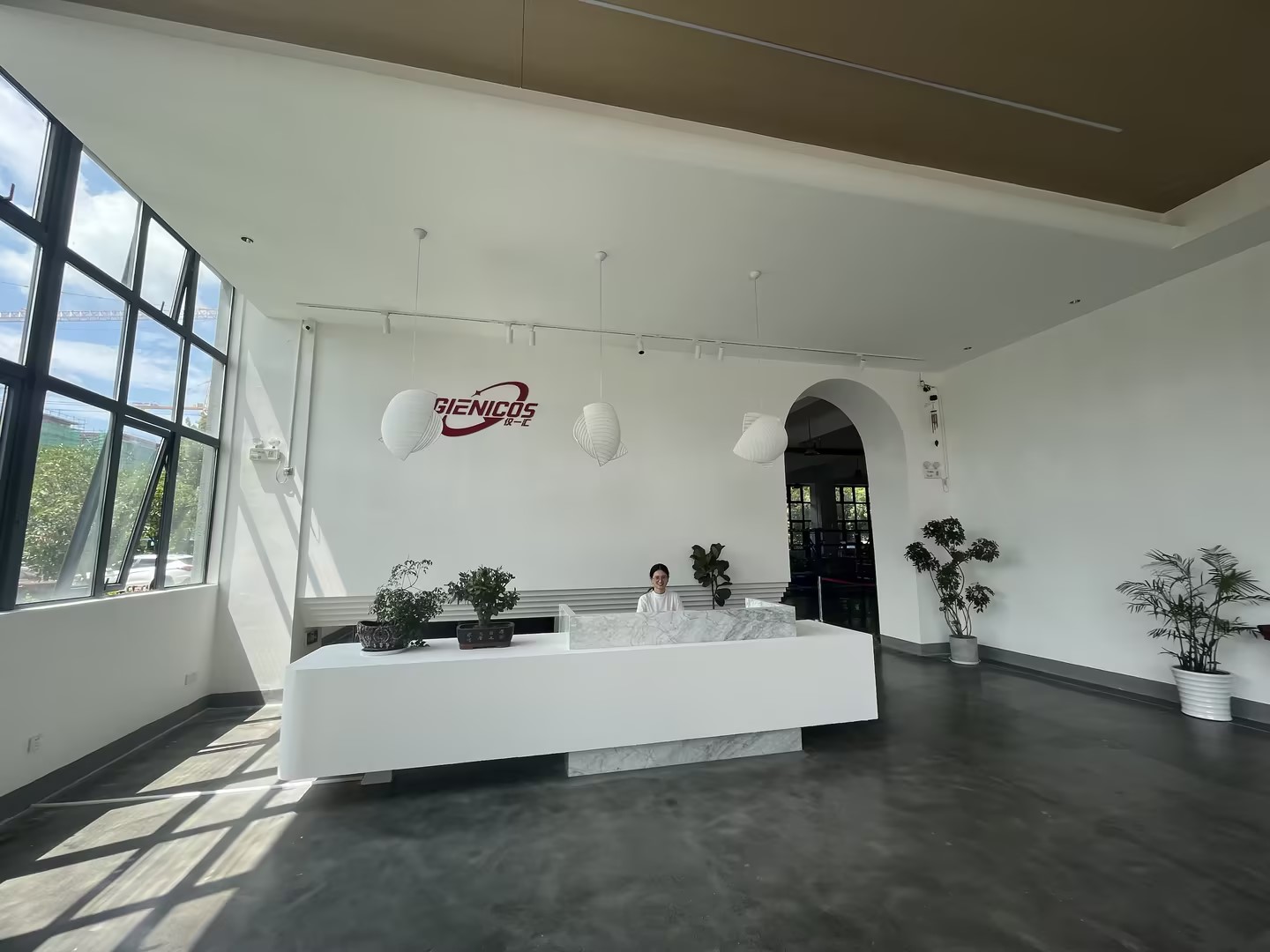
Factory visits are part of the evaluation route: GIENICOS operates from Jiading District, Shanghai, approximately 40 minutes by road from Shanghai Hongqiao International Airport.
Conclusion
Servo piston and peristaltic filling heads answer different questions. Servo piston metering fixes the dispensed volume geometrically and is the architecture that holds ±0.1 g on the GIENICOS models where that figure is published, which is why it dominates hot-filled wax formats, thick creams, high-speed lipgloss and mascara lines, and any application where net-content tolerance is a commercial commitment. Peristaltic metering removes the product from the pump body and is the architecture for low-viscosity, seal-sensitive liquids, which is why it is specified on the JR-02E eyeliner filling machine. Neither head is a compromise solution to the other's problem.
For an engineer at the evaluation stage, the decision narrows to four verifiable inputs: the formula's viscosity at filling temperature, the tolerance budget left after container and density variation, the cleaning and changeover route that the shift pattern can absorb, and a CE scope that names the exact model. Get those four right and the architecture choice becomes obvious; get them wrong and no tolerance figure on a datasheet will hold on the line. Product-contact materials, published cleaning times such as the JMF 30-minute figure, changeover times such as the JRS-G3 15-minute figure, and line-level CE coverage are all checkable before a purchase order is raised.
Next step: validate the head on your own formula
Send your product viscosity, container dimensions and target net-content tolerance, and GIENICOS will recommend the appropriate filling head — servo piston, peristaltic or another metering principle — and quote accordingly. MOQ is 1 unit and customization covers voltage, logo, automation degree, tank size, filling method and speed request.
Contact: GIENICOS · sales@genie-mail.net · Tel / WhatsApp +86 134 8206 0127
Download the 2026 GIENICOS catalogue (PDF) for full model parameters across filling, hot filling and cooling, capping, labeling and powder processing equipment.
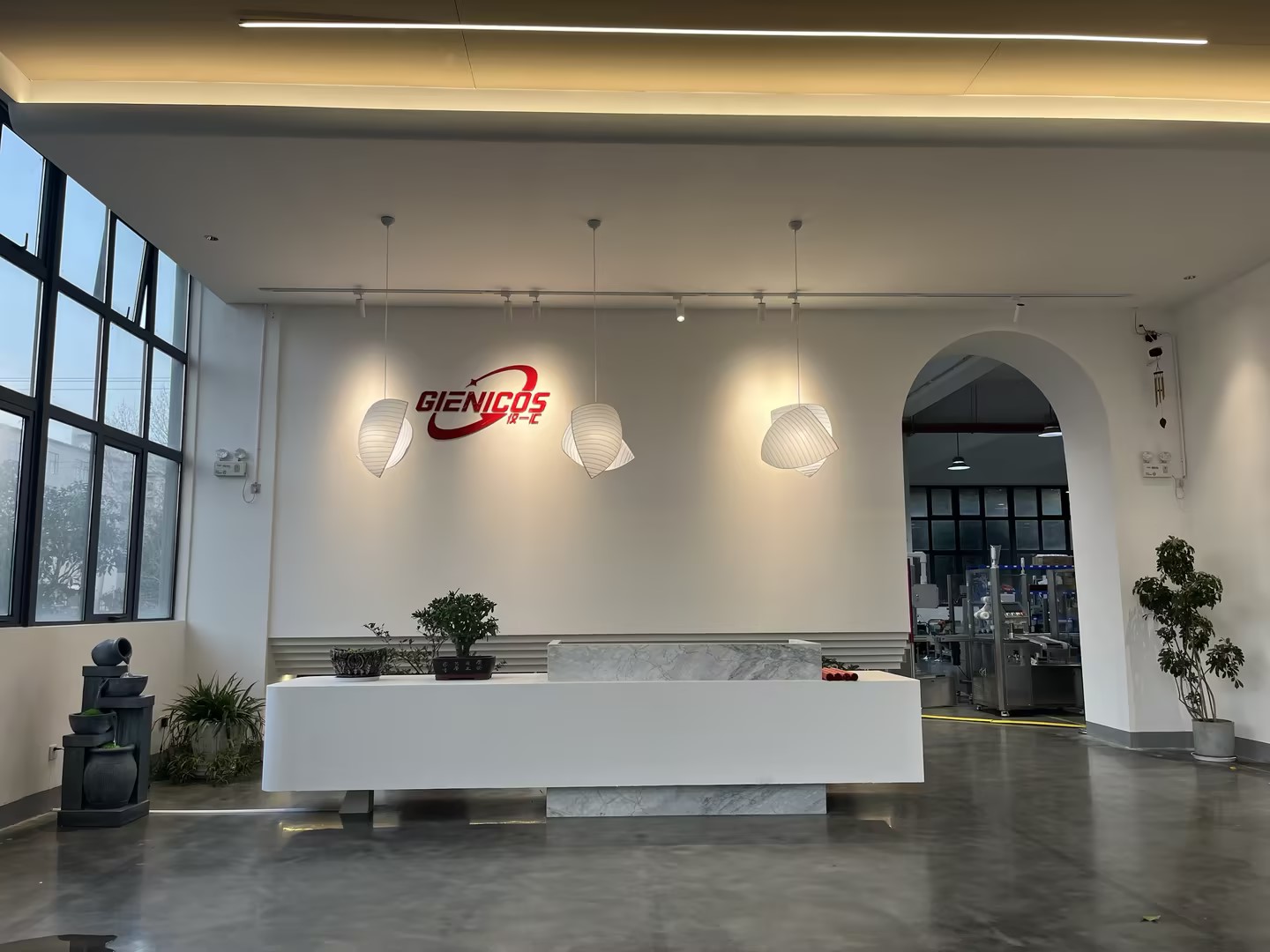
Sample validation, quotation and catalogue requests are handled by the GIENICOS project team in Shanghai.
Have Questions or Need More Details?
Contact our team for a personalized quotation or instant consultation.
Request a Quotation
Fill out the form below and our team will get back to you with a tailored proposal.
WhatsApp Direct Chat
Prefer to chat in real-time? Message us on WhatsApp for instant assistance & quick answers.
- Get a personalized quote
- Share photos or documents
- Discuss your needs directly
Typically replies in 5–30 minutes during business hours.