Cosmetic Filling Machine Basics: Hot Pouring, Rotary, Capping
Cosmetic Filling Machine Basics: Hot Pouring, Rotary Filling, and Capping Explained
A cosmetic filling machine is production equipment that dispenses a cosmetic bulk into its retail container and then closes it. For readers new to cosmetic manufacturing, four machine families explain most of the vocabulary: hot pouring (also called hot filling), rotary filling, capping, and labeling. Hot pouring handles wax-based bulk that must stay molten, such as lipstick and lip balm. Rotary filling handles products that flow at room temperature, such as nail polish, lip gloss, mascara, foundation, and skincare emulsions. Capping applies and torques the closure. Labeling identifies the finished unit after it is filled and closed. Each family has its own machine shapes, its own parameters, and its own model naming.
This explainer defines those categories and the process terms that sit between them. The reference examples are documented GIENICOS models — the 20L Hot Pouring Machine MT 20P, the Rotary Nail Polish Filling Machine JQR-01N, the Semi Automatic Rotary Capping Machine JR-01X, and the Horizontal Round Container Labeling Machine JTB — so that each definition is anchored to a real machine configuration rather than to abstract wording. GIENICOS (Shanghai GIENI Industry Co., Ltd.) is a Shanghai-based manufacturer of cosmetic filling and packaging equipment founded in 2011, with 80% of its output exported to the EU, USA and Asia.
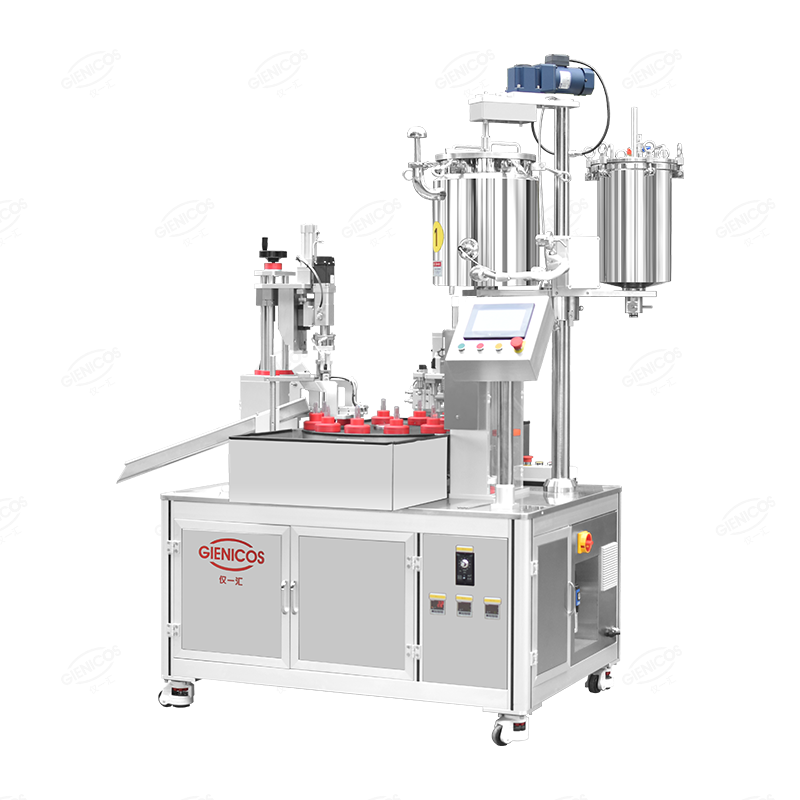 A rotary cosmetic filling machine: containers index around a rotating table past the dosing station. Image: GIENICOS.
Why Cosmetic Filling Terminology Is Difficult to Pin Down
A single machine name in this industry can describe three different things at once. One part of the name may describe the material state — hot versus ambient. A second part may describe the transport principle — rotary versus linear. A third part may describe the function — filling, capping, labeling, or cooling. The name “Rotary Nail Polish Filling Machine” combines a transport principle with a product category. The name “20L Hot Pouring Machine” combines a tank volume with a thermal process. Neither name tells you the pump type, the dosing precision, or the container size the machine accepts, because those are separate parameters listed in the specification.
The second source of confusion is that “hot filling” and “hot pouring” describe overlapping scopes rather than competing processes. GIENICOS uses both terms for different machines. The 20L Hot Pouring Machine MT 20P is described as a lipstick and lip balm material melting and pouring machine: its job is to hold wax-based bulk at temperature and dispense it. The Hot Filling & Cooling Line JHF is described as a multi-functional lipbalm chapstick hot filling and cooling line: its job is to fill and then solidify product on a continuous conveyor. One is a unit operation, the other is a line.
The third source is line balance. A semi-automatic rotary capping machine such as the JR-01X is rated at 30–40 pcs/min, which is the same nominal band as the semi-automatic rotary filling machines it usually sits beside. A filling line does not run at the speed of its fastest station; it runs at the speed of its slowest one. Reading a single speed figure out of context therefore tells a newcomer very little about line capacity.
How the Cosmetic Filling Machine Category Is Structured Today
The category is small, specialised, and growing steadily, which is part of why the vocabulary has not yet standardised. Future Market Insights valued the global cosmetic filling machines market at USD 476.80 million in 2025 and projected USD 718.63 million by 2036. That figure covers specialised equipment that dispenses cosmetic formulations into containers, not packaging machinery as a whole.
Production is concentrated. Asia Pacific held a 33.08% share of the filling machine market in 2025, according to Fortune Business Insights, which reflects both the density of contract manufacturers in the region and the location of most equipment builders, GIENICOS included.
Automation is expanding but is not yet the whole market. Automatic filling machines are projected to hold a 41.2% share of the cosmetic filling technology market in 2026, per Future Market Insights — which means semi-automatic rotary and linear machines remain a substantial part of the installed base in factories that change formulas and SKUs frequently.
Within the category, lipstick automation is tracked as its own segment. Strategic Revenue Insights projects the automatic lipstick filling machine market at USD 1.2 billion by 2033, growing at a 5.8% CAGR from 2025. Published estimates for this segment vary widely because definitions differ — a narrow count of individual machines produces a far smaller number than a count that includes complete filling and cooling lines — so segment figures should always be read together with their definition.
For anyone handling documentation, cosmetic filling machines fall under HS Code 8422.30, covering machinery for opening, filling and closing containers, with 8422.30.91 the specific line for this equipment in the US tariff schedule. The classification matters because it appears on import paperwork long before a machine reaches the factory floor.
The Four Core Machine Categories, Defined
Hot Pouring and Hot Filling: Machines for Wax-Based Bulk
Hot pouring is the process of holding a molten cosmetic bulk at a controlled temperature, dosing it into a container or a mold, and then allowing it to cool into its final solid form. It applies to lipstick, lip balm, and other wax-based bulk. Because the material is solid at room temperature, the machine must combine heating with the filling function; the thermal system is not an accessory but part of the process.
The 20L Hot Pouring Machine MT 20P is the smallest form of this category in the GIENICOS range. It has a 20 L tank and combines heating, stirring and vacuum functions in one unit, with a sanitary discharge valve without dead angles. Product-contact parts, including the tank and the discharge valve, are stainless steel. It is used to prepare and pour lipstick, lip balm and other wax-based cosmetic bulk, and it can serve as a material preparation unit ahead of a downstream hot filling operation.
The Automatic Silicone Mold Lipstick Filling Machine GLU-1300 shows the same category at production scale. It runs 1000–1300 pcs/hour using a servo-driven piston pump and two filling nozzles, with a 30 L material tank heated by electric oil heating. Its silicone mold holds 112 pieces, and two LEISTER hot air guns heat the mold surface before filling, with hot-air blowing rate and heating rate adjustable by formula. It handles lipstick diameters of approximately 8–17.1 mm and runs with two operators, or one when robot integration is added.
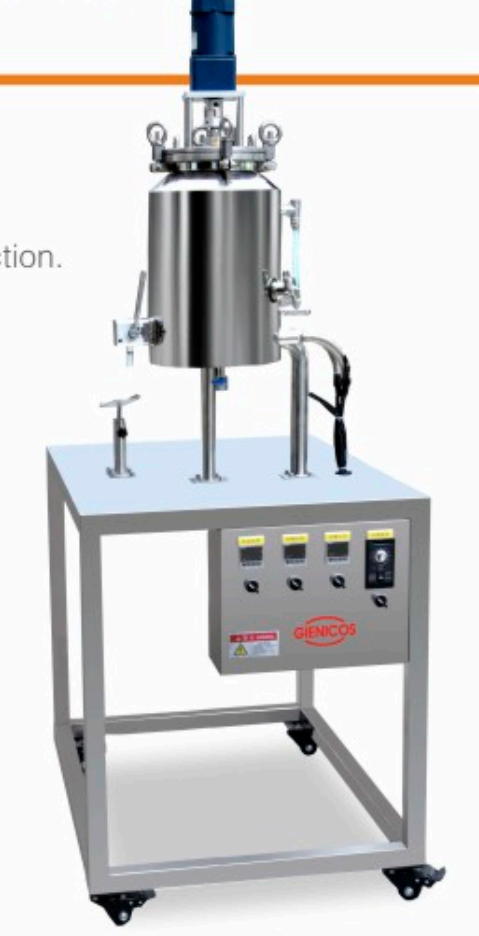 MT 20P 20L Hot Pouring Machine: heating, stirring and vacuum in one 20 L unit, with a dead-angle-free sanitary discharge valve.
Cooling is treated as part of hot filling rather than as a separate discipline. The Lipstick Cooling Tunnel JCT uses refrigerated air circulation and a continuous conveyor-type tunnel to cool and solidify hot-filled lipstick and lip balm molds, connecting directly to filling equipment; temperature, conveyor speed, dimensions and power supply are customizable to line requirements. The Hot Filling & Cooling Line JHF combines the two functions in one configurable line: filling volumes of 1–20 mL, 20–50 mL, 50–100 mL or 100–200 mL; 2, 4, 6 or 16 nozzles depending on configuration; and up to 60 pcs/min with a six-nozzle setup.
Not every hot-pour product is a wax stick. The Eyebrow Pencil / Eyeliner Gel Filling Production Line JPF-12 integrates oil spraying, mold preheating, filling, cooling, demolding, screw-down and capping for eyebrow pencil, eyeliner gel and KAJAL products, with a 2–10 mL filling range, 45–50 pcs/min, and cooling at approximately −1°C to −2°C to solidify the product after filling.
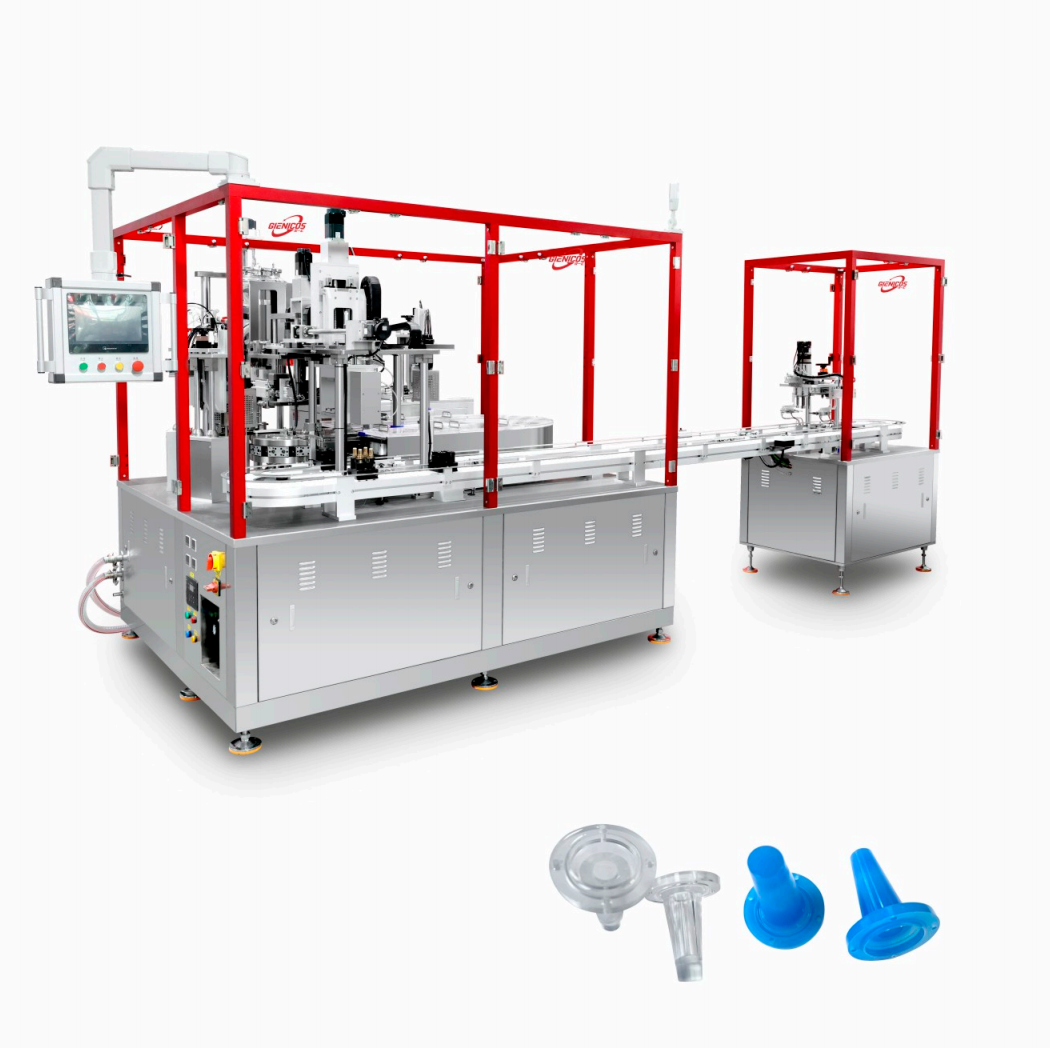 GLU-1300 automatic silicone mold lipstick filling machine: 1000–1300 pcs/hour, 112-piece silicone mold, two LEISTER hot air guns.
Rotary Filling: Machines That Index Containers Past a Dosing Station
Rotary filling describes how containers travel, not what is inside them. Containers are loaded onto a rotating table and indexed past one or more dosing stations, which is why the same rotary platform appears across nail polish, lip gloss, mascara and foundation equipment. What changes between models is the pump — peristaltic, ceramic, stainless-steel or servo piston — because the pump determines which viscosities can be dosed accurately.
The Rotary Nail Polish Filling Machine JQR-01N uses piston, vacuum or pressurized filling and accepts containers from 5–30 mL with a filling precision of about ±0.2 g. It operates on AC220V, single phase, 50/60 Hz at 2 kW, and its working sequence runs bottle feed, filling, brush feed, cap feed, capping and discharge — a reminder that on nail polish and similar products, brush insertion belongs to the filling cycle, not to a separate machine.
The Semi Automatic Mascara Lipgloss Filling Machine JR-01M/L is a single-nozzle rotary machine for lip gloss, mascara, foundation and lip oil. It fills 2–14 mL or 10–50 mL by changing spare parts, runs 30–40 pcs/min with lip gloss as the example, and can be fitted with either a ceramic pump or a stainless-steel pump depending on the material. Two details matter for newcomers: bottom-up filling with nozzle lifting helps reduce bubbles in viscous bulk, and the fast-cleaning structure allows disassembly and cleaning in approximately three minutes when switching between mascara and lip gloss.
Its dual-nozzle counterpart, the JR-02M/L, fills 1–20 mL at ±0.1 g and also runs 30–40 pcs/min, with a process that includes bottle loading, mold detection, automatic filling, rejection, brush-cap loading, automatic capping and discharge. At the automatic end, the JQR-01A integrates filling and capping on a rotary platform at 40–45 PPM, filling 2–14 mL at ±0.1 g across containers 10–125 mm in diameter and 40–90 mm in length excluding the cap.
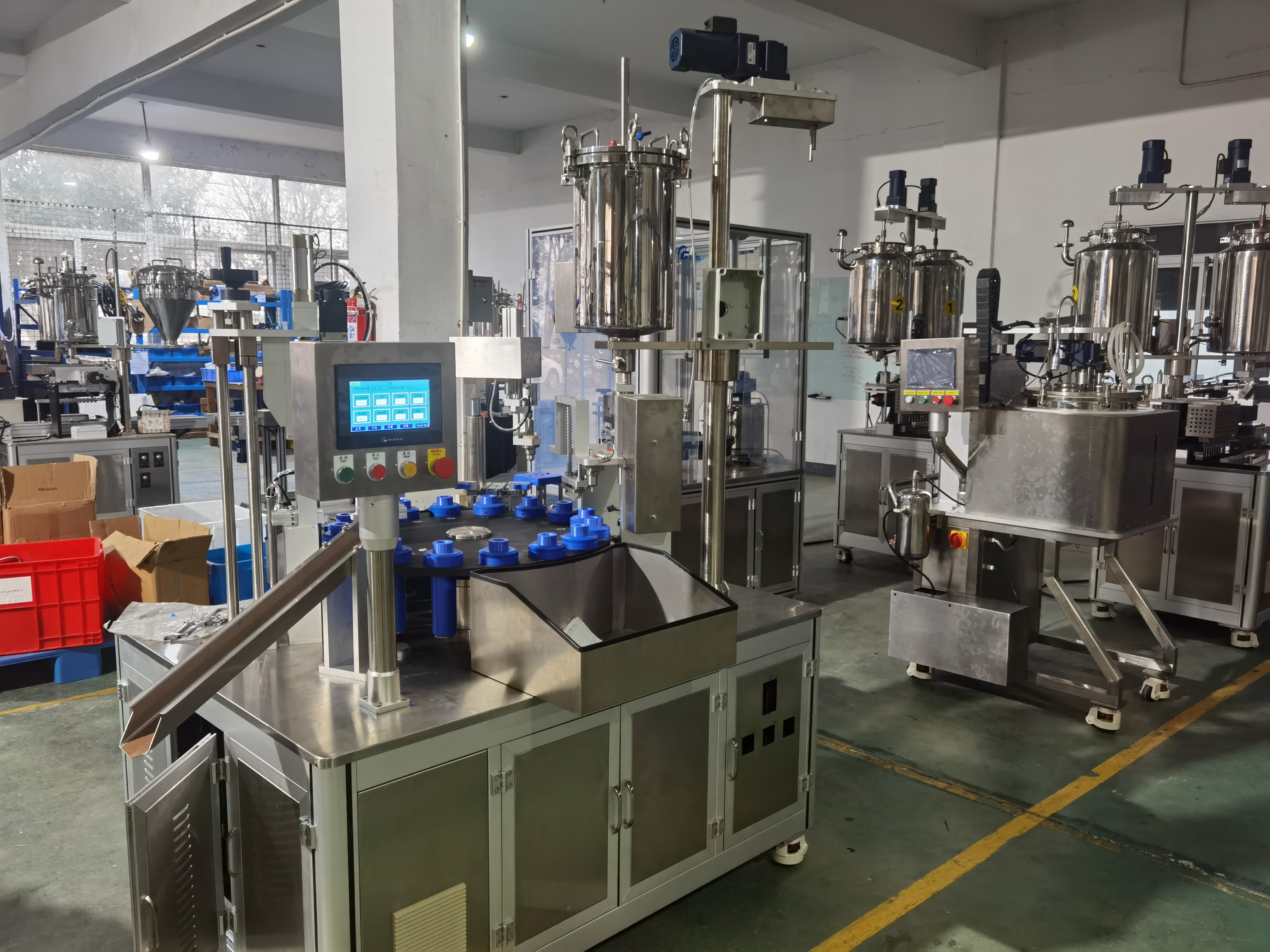 A rotary filling machine on the GIENICOS factory floor. Rotary describes the container transport principle, not the product type.
For contrast, a linear line such as the JMG moves containers on a straight conveyor instead of a rotating table. It runs at 60–72 pcs/min mid-speed or 80–100 pcs/min high-speed, fills 10–12 pcs per cycle with servo piston filling, uses a return-suction anti-drip nozzle to reduce bottle-mouth contamination, and includes no-bottle no-fill detection. The distinction between rotary and linear is therefore about throughput model and floor space, not about product compatibility.
Capping: Closing the Container and Controlling Torque
Capping is the step that applies the closure and tightens it to a specified torque. It is where a filling line most often loses consistency, because the correct torque depends on the cap material, the thread, and the container wall thickness — and because an over-tightened cap can crack or deform while an under-tightened one leaks.
The Semi Automatic Rotary Capping Machine JR-01X handles round and square bottles with servo capping at 30–40 pcs/min and adjustable capping torque. It runs on single-phase 220 V at 1.5 kW and 7 A, requires air pressure of 0.5–0.8 MPa, and is built on a stainless-steel and aluminium-alloy structure with servo-driven capping components. Its stated applications are lip gloss, liquid lipstick, mascara and concealer packaging, and it can operate alongside a single-nozzle filling machine.
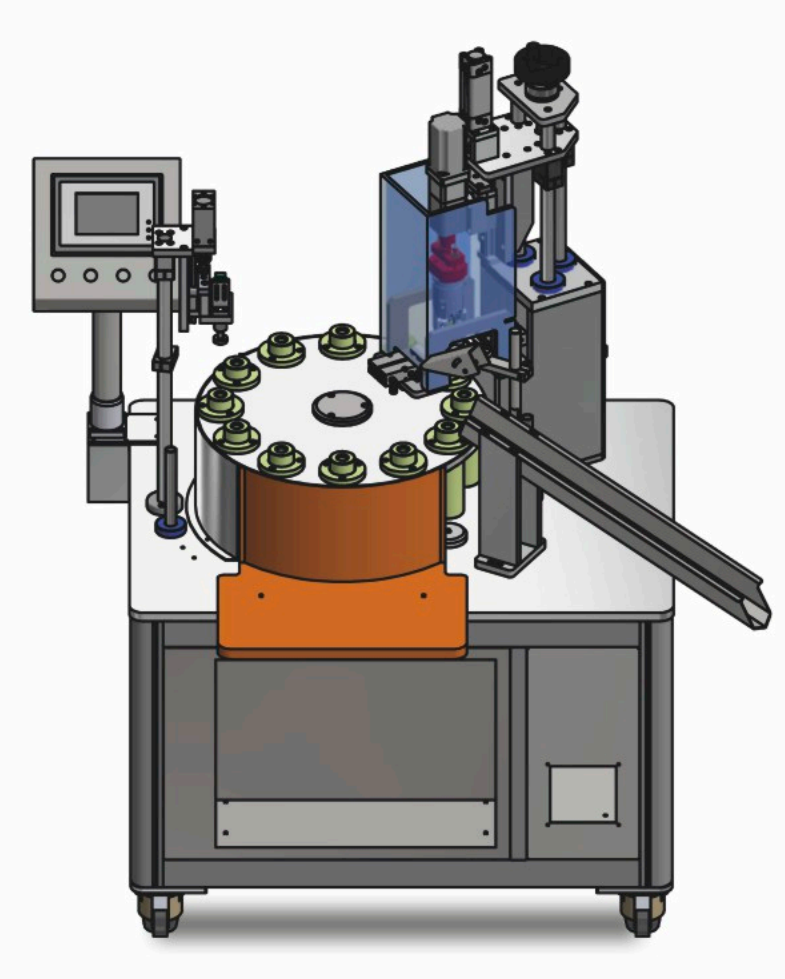 JR-01X Semi Automatic Rotary Capping Machine: servo capping, adjustable torque, 30–40 pcs/min on round and square bottles.
On higher-speed lines, capping is folded into the filling platform. The JMG line uses servo torque capping with adjustable torque and speed for cap protection, so the same control that sets fill volume also governs how firmly each cap is closed.
Labeling: Identification After Filling
Labeling applies the printed identity of the product — the wrap-around label, the bottom colour code, or the shrink sleeve. Newcomers often treat these as one machine type, but they solve different problems on different container geometries, and manufacturers name them separately for that reason.
The Horizontal Round Container Labeling Machine JTB is built for slim round containers of the type used for lipstick, lip balm, mascara and sunstick. It runs on AC 220 V, single phase, 50/60 Hz at 600 W, labels at 0–25 m/min with accuracy of ±0.1 cm excluding container and label variation, and accepts bottles 1–2.5 cm in diameter and 2.5–10 cm in height with label widths of 1–12 cm. Label rolls use a 7.6 cm inner diameter and up to 36 cm outer diameter, and the stainless-steel and aluminium-alloy structure is designed to meet GMP production requirements.
The Bottom Color Code Labeling Machine JTB-815S solves a different problem: applying a colour code to the base of a slim container for identification. It handles containers 15–30 mm in diameter and 50–110 mm in length at 60–90 pcs/min with ±1 mm accuracy and a minimum label length of 9 mm, running on AC 220 V ±5%, 50 Hz at 2 kW.
The Sleeve Shrink Labeling Machine JSS-01 covers the third case, full-body sleeving for slim and long items such as lipstick, mascara, lip gloss, pencil boxes and oil bottles. It labels at 100 pcs/min with film cut precision of ±0.25 mm, works with PE, PVC, OPS and PET film at 0.035–0.045 mm thickness, heats film up to 200°C, and uses a rotating heating conveyor to promote even shrinkage.
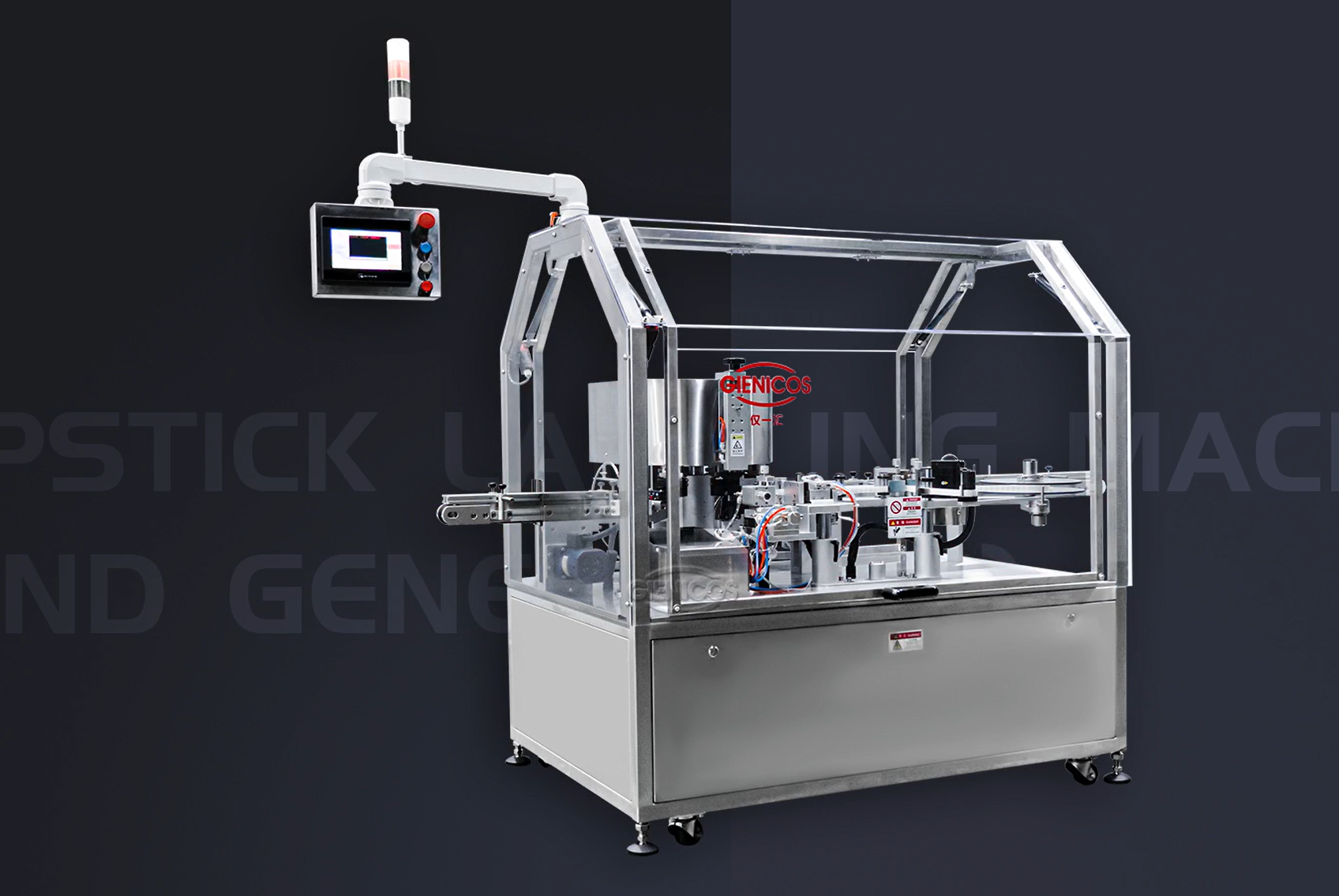 JTB-815S Bottom Color Code Labeling Machine: 60–90 pcs/min on 15–30 mm containers, with ±1 mm labeling accuracy.
How a Cosmetic Filling Sequence Runs, Step by Step
Once the categories are separated, a production sequence becomes easier to read. The steps below follow the order in which product moves through a typical cosmetic filling operation.
- Bulk preparation and melting. Wax-based bulk is melted and held in a tank. The MT 20P does this in a 20 L vessel with heating, stirring and vacuum; larger batches use the MT 300 SE with 300 L capacity and oil circulation heating, or the MT 30SE with 30 L capacity plus heating, mixing, vacuum and tank-lid lifting.
- Transfer at temperature. Molten material leaves the tank through the sanitary discharge valve without dead angles on the MT 20P, which limits material held in the valve body between pours.
- Dosing. The bulk is dispensed either into molds, as with the GLU-1300 and its 112-piece silicone mold, or directly into retail containers, as on rotary machines such as the JR-01M/L, where bottom-up filling reduces bubbles.
- Cooling and solidification. Hot-filled molds pass through a cooling stage. The JCT uses refrigerated air circulation on a continuous conveyor; the JPF-12 holds cooling at approximately −1°C to −2°C before demolding.
- Demolding and assembly. The GLU-1300 uses a two-stage vacuum demolding system to release lipstick from silicone molds, while the JPF-12 performs automatic cooling, demolding, screw-down and capping in one workflow.
- Capping. Closures are applied and torqued. The JR-01X applies servo capping with adjustable torque to round and square bottles at 30–40 pcs/min.
- Labeling and check. The JTB applies wrap-around labels at 0–25 m/min; the JTB-815S applies base colour codes at 60–90 pcs/min. On the JHF line, a check weigher is listed within the certified equipment scope, positioned after capping and before labeling.
Use Cases: Which Category Fits Which Product Format
Product format, not brand or batch size, is the first sorting rule. The examples below map formats to documented machine configurations.
- Lipstick and lip balm: hot pouring plus cooling. The MT 20P prepares and pours the bulk; the GLU-1300 fills silicone molds at 1000–1300 pcs/hour; the JCT solidifies the filled molds on a conveyor.
- Lip balm and chapstick at line scale: the JHF hot filling and cooling line, configured with 2, 4, 6 or 16 nozzles and filling ranges from 1–20 mL up to 100–200 mL.
- Nail polish: the JQR-01N rotary machine for 5–30 mL containers at about ±0.2 g, running bottle feed, filling, brush feed, cap feed, capping and discharge in one cycle.
- Lip gloss and mascara: the JR-01M/L single-nozzle rotary machine for 2–14 mL or 10–50 mL at 30–40 pcs/min, or the JQR-01A automatic rotary filling and capping machine at 40–45 PPM.
- Liquid eyeliner: the JR-02E rotary machine, which fills two products per cycle by peristaltic pump at 30–40 pcs/min and includes automatic steel-ball feeding, in-position detection and inner wiper feeding.
- Eyebrow pencil, eyeliner gel and KAJAL: the JPF-12 integrated line, filling 2–10 mL at 45–50 pcs/min with cooling at approximately −1°C to −2°C.
- Toner, lotion, serum and cream: the JRS-G2 dual-nozzle servo machine fills 10–300 mL at normal pressure for materials up to 15,000 mPa.s, at 45 bottles/min for a 50 mL fill with a 40–45 L tank.
- Cushion and foundation: the JQL-04C cushion filling machine uses four servo nozzles at 30–40 pcs/min for 5–20 mL at ±0.15 g; the JRS-G1 rotary foundation machine runs 30–40 pcs/min for cream and liquid foundation.
- Powder formats: the JLF-A loose powder machine fills 30–40 pcs/min with dual-nozzle auger filling, a 25 L hopper and SUS316L product-contact parts; compact powder uses the JBC-4 hydraulic press at 720–1080 pcs/hour, or the servo-hydraulic JBC-5 at 2–3 molds per minute with up to 9 pans per mold at approximately 50 mm pan diameter.
Category Comparison at a Glance
The table below compares the four families using only documented parameters. It is a definition aid, not a selection tool: the correct machine for a given product depends on the container, the formula, and the required output, which are specified separately.
| Category | Primary function | Typical materials | Documented example | Documented parameters |
|---|---|---|---|---|
| Hot pouring | Melts, holds and dispenses molten wax bulk | Lipstick, lip balm, wax-based bulk | 20L Hot Pouring Machine MT 20P | 20 L tank; heating, stirring and vacuum; sanitary valve without dead angle; stainless-steel product-contact parts |
| Hot filling and cooling | Fills molds or containers, then solidifies the product | Lip balm, chapstick, lipstick, eyebrow pencil gel | Hot Filling & Cooling Line JHF with JCT cooling tunnel | 1–20 / 20–50 / 50–100 / 100–200 mL; 2 / 4 / 6 / 16 nozzles; up to 60 pcs/min with 6 nozzles; refrigerated air circulation cooling |
| Rotary filling | Indexes containers past dosing stations and dispenses liquid or paste | Nail polish, lip gloss, mascara, foundation, eyeliner | Rotary Nail Polish Filling Machine JQR-01N; JR-01M/L | JQR-01N: 5–30 mL, about ±0.2 g, AC220V 1P, 2 kW. JR-01M/L: 2–14 mL and 10–50 mL by spare parts, 30–40 pcs/min |
| Capping | Applies and torque-controls the closure | Lip gloss, liquid lipstick, mascara, concealer bottles | Semi Automatic Rotary Capping Machine JR-01X | 30–40 pcs/min; servo capping; adjustable torque; single-phase 220 V; 1.5 kW; 0.5–0.8 MPa; round and square bottles |
| Labeling | Applies wrap-around, base or sleeve labels | Lipstick, lip balm, mascara, sunstick containers | Horizontal Round Container Labeling Machine JTB; JTB-815S | JTB: 0–25 m/min, ±0.1 cm, bottles 1–2.5 cm diameter, 2.5–10 cm height. JTB-815S: 60–90 pcs/min, ±1 mm, 15–30 mm containers |
Where CE Certification Attaches to These Categories
For a newcomer, certification is often the first place where categories stop being abstract. A CE certificate is issued for a defined scope that names model series, so the certificate itself tells you which machine family it belongs to and which configurations are covered.
GIENICOS holds CE certificates issued by Hunan Anbotek Compliance Laboratory Limited and Anbotek (Guangzhou) Compliance Laboratory Limited, all assessed against EN 60204-1:2018 and EN ISO 12100:2010. Representative examples:
- Hot filling line: certificate AT185114C4000321, issued 2024-07-17, covering the MT melting tank, JYF filling machine, JCT cooling machine, automatic bottle loading machine, automatic cap loading machine, check weigher and JTB labeling machine, under the model series JHF-1, JHF-2, JHF-4, JHF-6, JHF-8 and JHF-10.
- Rotary filling machine: certificate AT18250SC100524, covering the JR-01 and JR-02 series in the E, M, L, N and P variants.
- Lipstick filling machine: certificate AT1814C500649151, covering JLG-10, JLG-12, JSM, FSM-5, FSM and JLG.
- Cushion filling machine: certificate AT1814C502723151, covering JQL-04C, JQR-02C and JQL-02C.
- Powder compacting machine: certificate AT18250SC100525, covering JBC, JTC, ZL, ZL-F and JAC.
- Powder mixer: certificate AT18250SC100526, covering the JY-CR and JY3-CR series.
- Melting tank: certificate ATGZAHS190528008-M1, covering MT-1, MT-4, MT-6, TSP, TSF and MT.
Two practical points follow from how certificates work. First, a model that does not appear in the certificate scope is not covered by that certificate, even if it belongs to the same machine family. Second, because the scope names specific series, a heavily modified configuration should be checked against the listed models before assuming coverage. Import documentation is a separate matter again: cosmetic filling machines are classified under HS Code 8422.30 for machinery that opens, fills and closes containers.
FAQ: Cosmetic Filling Machine Basics
Which GIENICOS cosmetic filling machines are CE certified?
CE certification is issued per machine scope, not per company. The hot filling line is covered by certificate AT185114C4000321, which names the MT melting tank, JYF filling machine, JCT cooling machine, automatic bottle and cap loading machines, check weigher and JTB labeling machine under the JHF-1 to JHF-10 series. The rotary filling machine series JR-01 and JR-02 in E, M, L, N and P variants is covered by AT18250SC100524. Lipstick filling models JLG-10, JLG-12, JSM, FSM-5, FSM and JLG are covered by AT1814C500649151; cushion filling models JQL-04C, JQR-02C and JQL-02C by AT1814C502723151; powder compacting models JBC, JTC, ZL, ZL-F and JAC by AT18250SC100525; powder mixers by AT18250SC100526; and melting tanks MT-1, MT-4, MT-6, TSP, TSF and MT by ATGZAHS190528008-M1. All are assessed against EN 60204-1:2018 and EN ISO 12100:2010.
How do I know whether a product needs hot pouring or rotary filling?
The deciding factor is whether the bulk flows at room temperature. Wax-based products such as lipstick and lip balm are solid when cool, so they are melted, poured and then solidified — the MT 20P for preparation and pouring, the GLU-1300 for mold filling, and the JCT for cooling. Products that already flow at room temperature are dosed by rotary filling, for example nail polish at 5–30 mL on the JQR-01N, lip gloss and mascara at 2–14 mL or 10–50 mL on the JR-01M/L, or toner and cream at 10–300 mL and up to 15,000 mPa.s on the JRS-G2. A third group solidifies after filling without being a wax stick — eyebrow pencil and eyeliner gel — and uses an integrated line such as the JPF-12, which cools at approximately −1°C to −2°C before demolding.
What is the minimum order quantity and lead time for a GIENICOS machine?
The minimum order quantity is one unit. Standard lead time is 45–80 days, and monthly capacity is 10 units. Machines are built in OEM/ODM mode with customization available on voltage, logo, automation degree, tank size, filling method and speed request, and every unit passes a 100% OQC test before shipping.
Can these machines be cleaned between formulas?
Cleaning time depends on the machine, but the design principle is modularity. The JR-01M/L allows disassembly and cleaning in approximately three minutes, with ceramic or stainless-steel pump options and quick-joint valves that make switching between mascara and lip gloss easier; its structure also supports programmable automatic cap lifting. Product-contact parts on machines such as the JLF-A loose powder filler and the JMG line are made of SUS316L stainless steel, and the JMG line is described as GMP-compliant with easy disassembly. The standard warranty is 12 months from machine acceptance, covering manufacturing defects and excluding wearing consumable parts and man-made damage.
How can I see a machine before deciding?
Factory visits take place at the GIENICOS site in the Baihao AI Technology Park, Jiading North Industrial Park, Jiading District, Shanghai — approximately a 40-minute drive from Shanghai Hongqiao International Airport and an 80-minute drive from Shanghai Pudong International Airport. The technical team numbers 10 engineers, and the company holds 42 authorized patents. The 2026 product catalogue can be downloaded here: GIENICOS 2026 Catalogue (PDF). For a specific product format, sending the container drawing and formula viscosity to sales@genie-mail.net or WhatsApp +86 134 8206 0127 is the fastest way to get a matching configuration described.
Conclusion
Cosmetic filling terminology becomes manageable once the categories are separated by what they actually do. Hot pouring prepares and dispenses molten wax bulk, and hot filling with cooling turns that bulk into a solid product. Rotary filling indexes containers past dosing stations to dispense liquids and pastes that already flow. Capping applies and torques the closure, and labeling identifies the finished container. Everything else in a specification — tank volume, nozzle count, pump type, filling range, precision, speed, torque, electrical supply and certificate scope — is a parameter attached to one of those four functions.
Start from the material state of the product, then read the model name for the transport principle, then check the parameter list for the constraints. That sequence resolves most of the confusion that surrounds the phrase “cosmetic filling machine” in the first place.
Need the category explained for your own product?
GIENICOS builds cosmetic filling, capping and labeling equipment in Shanghai and exports to the EU, USA and Asia. Send a container drawing and a formula viscosity to sales@genie-mail.net, or reach the team on WhatsApp at +86 134 8206 0127, and you will receive a machine category description with the matching parameter list.
Have Questions or Need More Details?
Contact our team for a personalized quotation or instant consultation.
Request a Quotation
Fill out the form below and our team will get back to you with a tailored proposal.
WhatsApp Direct Chat
Prefer to chat in real-time? Message us on WhatsApp for instant assistance & quick answers.
- Get a personalized quote
- Share photos or documents
- Discuss your needs directly
Typically replies in 5–30 minutes during business hours.