Servo Piston Filling Machine: Cosmetic Filling Parameters & Selection
Servo Piston Filling Machine: Cosmetic Filling Parameters & Selection
A servo piston filling machine doses cosmetic product by displacing a fixed cylinder volume with a servo-driven piston, and the quality of the fill is decided long before the machine reaches the filling hall. It is decided when four constraints are written into the specification: how the dosing system behaves across the viscosity range you actually run, how accurately it repeats a target weight shot after shot, how it manages the container-mouth and nozzle interface, and whether the exact model can be documented for the market you ship into.
This guide separates those constraints from the marketing numbers, then converts them into a selection sequence for creams, lotions, gels, toners and hot-poured wax products. It also shows where dosing parameters stop and where the surrounding line — capping, check-weighing, labeling — starts to set your real output.
Direct answer: specify a servo piston filling machine for cosmetics in this order — filling range and accuracy first, then nozzle count and cycle rate, then wetted material and cleaning time, then container and cap interface, and only then commercial terms. In the GIENICOS range, a ±0.1 g filling accuracy is quoted on the JYF-4 multi-color hot filling machine, the JR-02M/L semi-automatic rotary filler and the JLG-10/12 lipstick filler, while production output runs from 30–40 pcs/min on semi-automatic rotary formats to 80–100 pcs/min on the JMG linear servo piston line.
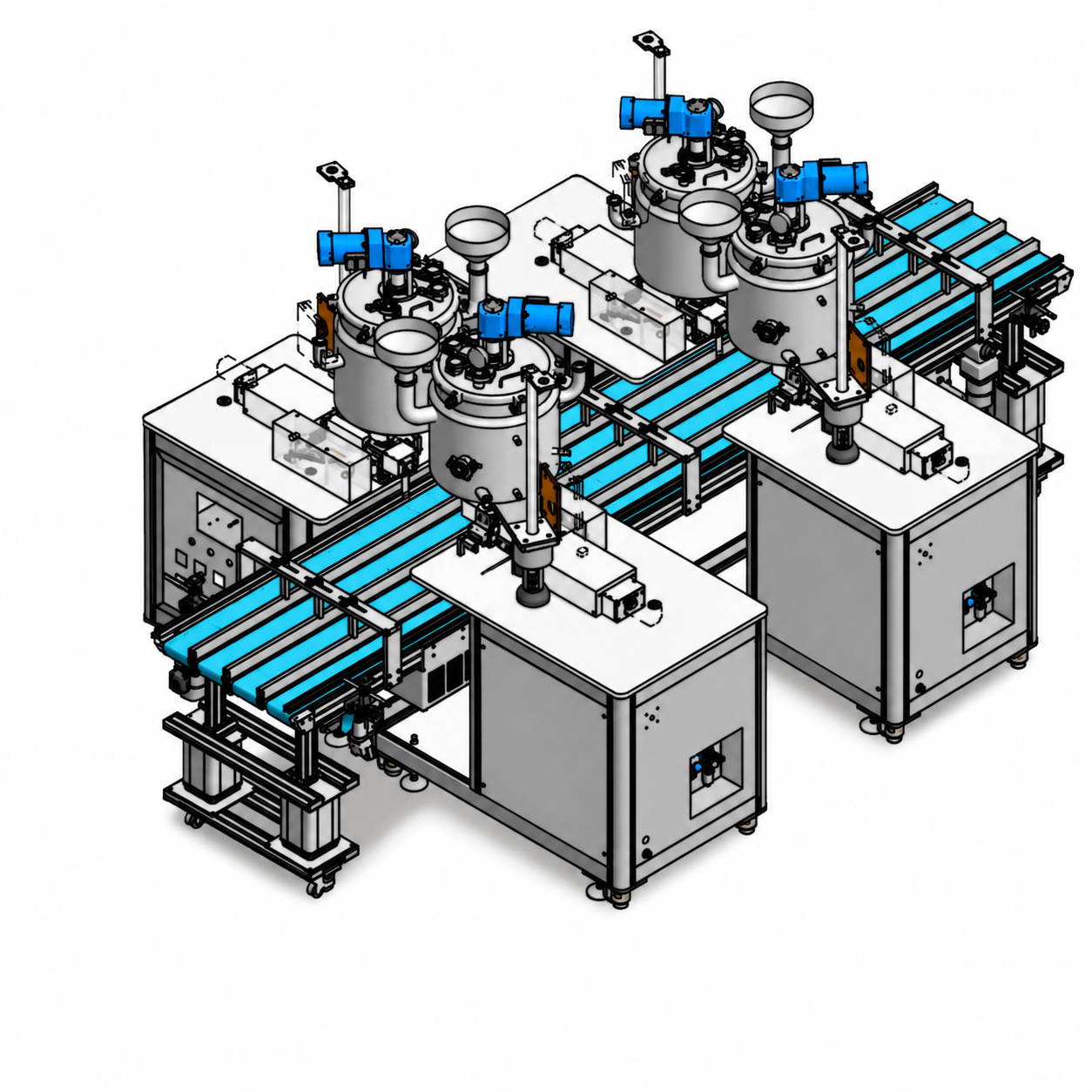
JYF-4 four-in-one hot filling line: four independently controlled single-head servo piston filling units, ±0.1 g filling precision, SUS316L product-contact parts.
Why Piston Dosing Parameters Decide Cosmetic Fill Quality
A cosmetic fill is not a generic liquid transfer. It is a defined mass of a shear-sensitive material, delivered through a narrow neck into a container that will be capped, labeled and shipped. Three failure modes appear again and again in production, and each of them maps to a specific machine parameter rather than to operator skill.
Weight drift across a run. A machine that holds tolerance for the first two hundred shots but drifts after an hour is a machine whose dosing system, motion profile and material supply were specified independently of each other. Repeatability is a function of how the piston is driven, how the material is fed, and how the fill is terminated.
Product on the bottle mouth. Residue at the mouth contaminates capping torque, weakens seal integrity and interferes with label adhesion on the shoulder. This is a nozzle and fill-termination problem — return-suction nozzles and bottom-up filling exist specifically to solve it.
Aeration and foaming. Low-viscosity products and gels trap air when the fill stream is dropped from above or terminated abruptly. Nozzle lift during filling and bottom-up delivery change the outcome more than any adjustment to pump speed.
The parameter sheet problem: a catalogue often quotes one filling volume and one accuracy figure. A real cosmetic line runs several SKUs. The JR-01M/L, for example, covers 2–14 mL and 10–50 mL only by changing spare parts, which means a “filling range” is really a changeover specification. Changeover time is a parameter too — the JR-01M/L is built with a fast-cleaning structure that allows disassembly and cleaning within approximately three minutes.
Where Servo Dosing Sits in the Cosmetic Filling Market
Automatic dosing is no longer a premium option in cosmetic manufacturing; it is the mainstream. According to Future Market Insights, the global cosmetic filling machines market was valued at USD 476.80 million in 2025 and is projected to reach USD 718.63 million by 2036. The same source projects that automatic filling machines will hold a 41.2% share of the cosmetic filling technology market in 2026 — a signal that buyers are specifying automation at the technology-selection stage, not as an upgrade afterwards.
Regional supply is concentrated. Fortune Business Insights reports that Asia Pacific dominated the filling machine market with a 33.08% share in 2025, which is consistent with the density of contract manufacturers and equipment builders across China, Southeast Asia and South Asia.
For cross-border procurement there is also a classification point that is frequently overlooked until shipping: cosmetic filling machinery falls under HS Code 8422.30, specifically 8422.30.91 for machinery used in opening, filling and closing containers. Getting that classification right at the quotation stage avoids customs rework later.
SHANGHAI GIENI INDUSTRY CO., LTD., which trades as GIENICOS, is a Shanghai-based manufacturer founded in 2011 that designs and builds intelligent cosmetic filling and packaging equipment plus robotic loading and unloading systems. The company operates a 2,000 m² factory with 30 employees including a 10-engineer R&D team, produces approximately 100 units per year, exports about 80% of output to the EU, USA and Asia, and holds 42 authorized patents covering invention patents, utility models and software copyrights. Its installed base includes private-label and contract manufacturers such as COSMAX, INTERCOS, Weckerle and Fiabila, alongside brand owners including L’Oréal, Winona and Chando.
The Parameter Set That Governs a Servo Piston Filling Machine
Nine parameter groups decide whether a servo piston filler will behave in your cleanroom. They are listed below in the order in which they constrain each other.
1. Piston and cylinder geometry: the dose is a volume decision
In a piston filler, the delivered dose is the cylinder bore area multiplied by the stroke. The servo motor controls the stroke and its velocity profile; the bore is fixed by the installed cylinder and piston set. That single mechanical fact explains why filling ranges are quoted as discrete bands rather than as one continuous span.
On the JYF-4 multi-color hot filling machine, the available filling volumes are 2–20 mL, 20–50 mL and 50–100 mL. On the JHF hot filling and cooling line, the range extends from 0.5 mL up to approximately 250 mL. On the JR-01M/L semi-automatic rotary filler, the two working ranges are 2–14 mL and 10–50 mL, achieved by changing spare parts.
For a buyer, the practical instruction is to send the smallest and largest target fill volume at inquiry stage, together with the number of SKUs inside that span. Every additional range band means an additional set of change parts, an additional cleaning step and an additional source of operator error. A single band that covers all your SKUs is worth more than a wider specification that forces weekly changeover.
2. Servo responsiveness and motion profile
Servo dosing earns its cost in the motion profile, not in the motor label. The JMG linear lipgloss and mascara filling line uses a servo-motor-driven piston filling structure for precise and consistent dosing, and it fills 10 or 12 pieces simultaneously per cycle. Critically, it offers two filling modes: static filling, or fall-while-filling.
That mode choice is a product decision, not a preference. Static filling suits products that must be dosed into a stationary container to protect the fill pattern; fall-while-filling shortens the cycle by moving the nozzle relative to the container. On the JR-01M/L, the servo filling system supports nozzle lifting during filling, and bottom-up filling helps reduce bubbles in cosmetic formulations. A special movement-control design supports stable electrical cam operation across the rotary cycle.
When comparing machines, ask four questions about the motion system: which fill modes are available; whether nozzle lift and bottom-up motion are driven by their own servo axes or by pneumatics; whether the profile can be stored per SKU and recalled from the touch screen; and whether cap-lift cycles before capping are programmable, as they are on the JR-01M/L.
3. Accuracy: how to read ±0.1 g correctly
A quoted filling accuracy of ±0.1 g is a mass tolerance. It appears on the JYF-4 four-in-one hot filling line, on the JR-02M/L semi-automatic rotary dual-nozzle filler with a 1–20 mL filling volume, and on the JLG-10/12 semi-automatic lipstick filling machine with a 1–20 mL range.
Three clarifications decide whether that number is meaningful for your product. First, the tolerance must be read against the dose: at a 1–20 mL range, a fixed gram tolerance represents a larger relative share of the shot than it does at a 50–100 mL dose, so small-volume producers should evaluate relative accuracy rather than absolute grams. Second, mass accuracy depends on the density stability of the incoming bulk, which is why tank condition and heating matter as much as the piston. Third, the tolerance is only closed-loop if the line can measure it: GIENICOS lines can be configured with an automatic check-weigher and rejection module, so that out-of-tolerance containers are removed rather than discovered at the customer.
4. Wetted materials, cleaning and GMP
Product-contact material is a hard constraint in cosmetics, not a preference. The JYF-4 uses SUS316L for product-contact parts. The JMG uses SUS316L wetted parts on a SUS304 frame, with a design that supports easy disassembly, cleaning and sterilization for GMP cosmetic workshop compliance. The JRS-G3 automatic toner and cream rotary filling machine is constructed with SS316L stainless steel to support hygienic production, and the cushion filling platform applies SUS316L wetted parts to meet cosmetic GMP hygiene requirements.
Cleaning is also a time parameter. GIENICOS builds to a modular structural design in which key assemblies support fast disassembly, convenient cleaning and spare-part replacement to minimise production downtime — a principle that matters most on cream and lotion lines where product residue is heavy and changeover happens between batches.
5. Container handling, anti-drip and waste control
Drip control is usually treated as a nozzle accessory. It is better treated as a yield parameter. The JMG filling nozzle is equipped with a return-suction function that effectively eliminates dripping and reduces bottle-mouth contamination. The same line has built-in container detection with a no-bottle-no-fill logic, so the filling station skips a cycle when no bottle is present and avoids material waste.
The JR-02M/L adds upstream detection of a different kind: the process includes bottle loading, mold detection, automatic filling, rejection, brush-cap loading, automatic capping and product discharge, with the automatic rejection function removing abnormal products during production.
6. Tank configuration and product conditioning
The tank is part of the dosing system because it sets the material head pressure and temperature that the piston draws against. The JYF-4 uses a 20 L effective tank with SUS316L contact parts. The JMG feeding tank supports multiple custom configurations, including a heating function, a pressurization function, a cone-shape movable lifting type and a mobile lifting feeding tank.
For hot-poured products the conditioning requirement escalates. The GLU-1300 automatic silicone mold lipstick filling machine uses a 30 L material tank with electric oil heating and a ceramic-ring electric heating material tank for wax-based formulas, plus a secondary mixing function to maintain uniform lipstick bulk during filling. Upstream of hot filling, the TSP hot pouring machine provides a 20 L tank suitable for small-batch production and can serve as a material preparation unit, equipped with a sanitary valve without dead angles.
7. Capping and downstream integration
A servo piston filler that outruns its capping station simply creates a queue. Capping must be specified in the same conversation as filling.
On the JMG line, capping is servo-torque controlled: torque, rotating speed and cycle parameters are fully adjustable on the touch screen, the mechanism automatically stops once the target torque value is reached to prevent cap damage, and the capping jaws can be adjusted to fit different cap shapes and heights. In semi-automatic rotary formats, capping is integrated into the same rotary table — the JR-02M/L process includes brush-cap loading, automatic capping and product discharge, and the JR-01M/L allows automatic cap lifting to be programmed before capping, with cap-lift cycles adjustable to different production requirements.
Labeling sets the other downstream boundary. The JTB-815S bottom color-code labeling machine runs 60–90 pcs/min at ±1 mm accuracy for containers of 15–30 mm diameter and 50–110 mm length, with a minimum label length of 9 mm — appropriate for lipstick and lipgloss bottoms. The JTB-812 handles top and bottom labeling at 50–80 pcs/min with ±1 mm accuracy across 30–100 mm containers. JTB units are designed to meet GMP production requirements and use a stainless steel and aluminum-alloy structure.
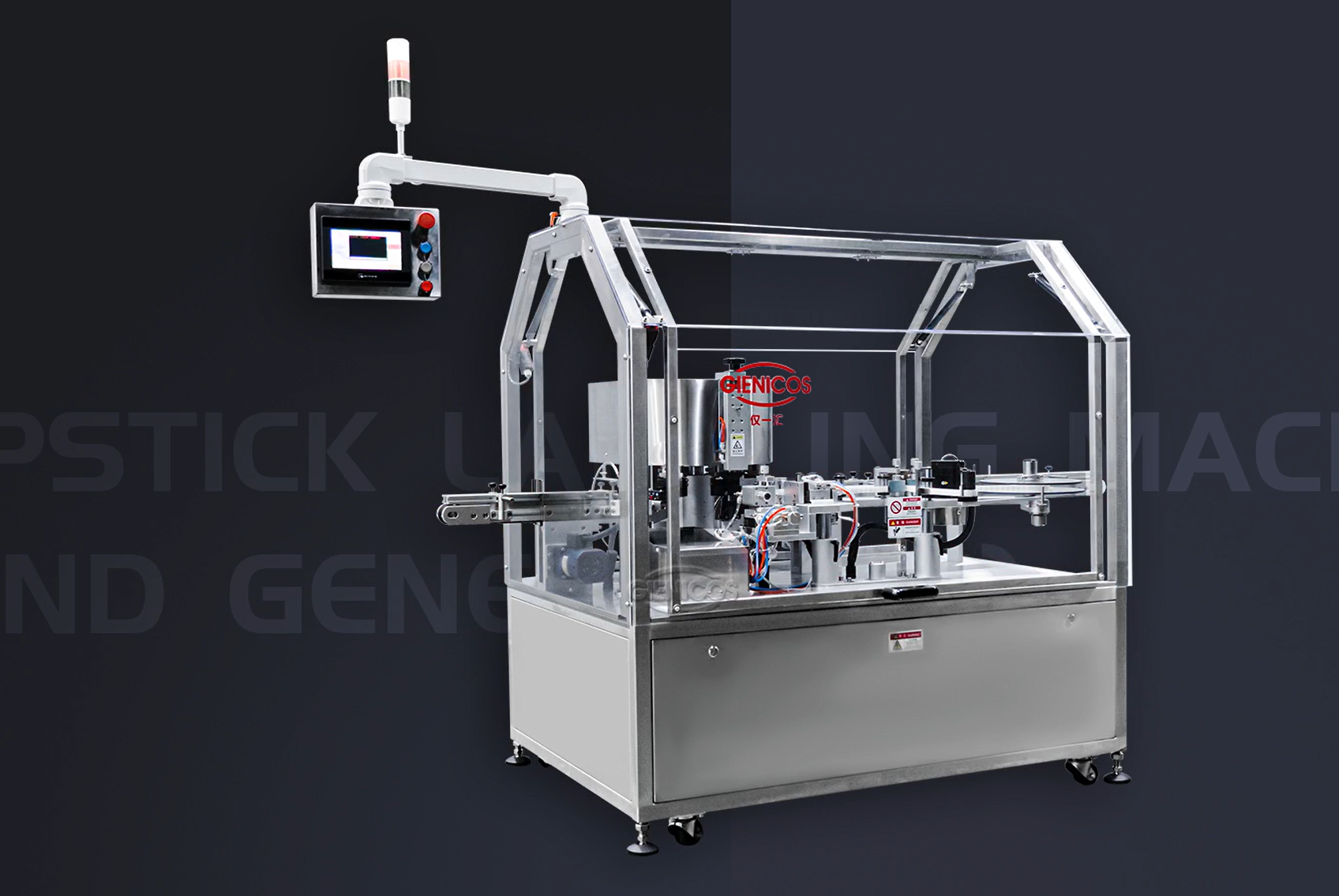
Downstream capacity must match filling output: JTB-815S labels slim cosmetic containers at 60–90 pcs/min with ±1 mm accuracy.
8. Compliance parameters: certificate scope, not certificate presence
For EU-bound equipment, CE documentation is a constraint that can stop a shipment. GIENICOS hot filling, rotary filling, cushion filling, lipstick filling, melting tank, powder mixer and powder compacting ranges carry CE certification against EN 60204-1:2018 and EN ISO 12100:2010, issued by Anbotek group laboratories.
The parameter a buyer must check is scope. Each certificate lists specific model series. The single-nozzle hot filling line JSFL is covered by certificate AT58250SC000523 issued 31 July 2020. The multi-functional filling production line series JYF-2 through JYF-12 is covered by AT58250SC100097 issued 19 April 2021. The rotary filling machine series JR-01-E through JR-02-P is covered by AT18250SC100524 issued 6 July 2021. The hot filling and cooling line JHF series is covered by AT185114C4000321 issued 17 July 2024. The air cushion CC cream filling range JQL-04C, JQR-02C and JQL-02C is covered by AT1814C502723151 issued 5 September 2025.
If the model on your purchase order does not appear in the scope list of a certificate, the certificate does not cover your machine. That is a documentary check, and it should be completed before the deposit, not before shipment.
Matching Dosing Parameters to Cosmetic Product Format
Creams, lotions, gels and toners are all “liquids” in a specification meeting and behave nothing alike in a piston filler. The table below translates product behaviour into the parameters that must be specified.
| Product format | Behaviour that affects dosing | Parameters to specify | Reference configuration |
|---|---|---|---|
| Creams and lotions | High viscosity, heavy residue, slow levelling in the container | Bottom-up filling, nozzle lift, heated or pressurized tank, wetted-part count for cleaning | JRS-G3 automatic toner and cream rotary filling machine (SS316L); JQH-02 for high-viscosity filling |
| Toners and low-viscosity liquids | Low viscosity, prone to dripping at fill termination, air entrapment | Return-suction anti-drip nozzle, no-bottle-no-fill detection, fill-termination profile | JMG linear servo piston line with return-suction nozzle |
| Gels, eyeliner and eyebrow gel | Thixotropic, sets quickly, needs temperature control after filling | Cooling stage, demolding, mold preheating, cycle timing | Eyebrow pencil and eyeliner gel filling line with −1 °C to −2 °C cooling |
| Lipgloss, mascara, lip oil | Medium viscosity, high SKU count, small dose, visible surface quality | 10–12 pieces per cycle, static or fall-while-filling mode, servo torque capping | JMG at 60–72 pcs/min mid-speed or 80–100 pcs/min high speed |
| Hot-poured wax products | Density changes with temperature; solidifies after fill | Heated tank, oil heating, temperature stability, cooling tunnel | JHF line (0.5–250 mL); JYF-4 (2–100 mL); GLU-1300 silicone mold line |
Two examples make the translation concrete. The eyebrow pencil and eyeliner gel filling machine integrates oil spraying, mold preheating, filling, cooling, demolding, screw-down and capping, with a cooling temperature of approximately −1°C to −2°C to support product solidification after filling; required air consumption is 0.4 m³/min, power is 12.5 kW, and the filling section runs on 3-phase 380 V while the demolding section runs on 1-phase 220 V. For a gel, temperature control after the valve is as much a dosing parameter as the piston stroke.
A second example sits at the other end of the viscosity scale. The BB CC Cushion Filling Machine uses high-speed 4-nozzle servo filling to keep filling weight consistent across cushion sponges, with SUS316L wetted parts for GMP hygiene — a reminder that in low-viscosity, high-absorption formats the number of nozzles and the servo response together determine uniformity, not the piston alone.
Step-by-Step: Specifying a Servo Piston Filling Machine
The sequence below is the order in which constraints should be locked, because each step removes options from the next.
- Define the product families and their viscosity classes. Group SKUs by behaviour — cream, lotion, toner, gel, hot-pour — rather than by brand. A machine specified for a cream and a machine specified for a toner share a piston but not a nozzle, not a tank and not a cleaning regime.
- Fix the dose band and the accuracy requirement. Give the minimum and maximum fill mass in grams, not millilitres only, and state the acceptable tolerance at the smallest dose. Check whether the quoted accuracy — ±0.1 g on the JYF-4, JR-02M/L and JLG-10/12 — is expressed at a dose comparable to yours.
- Calculate the required output, then choose heads and cycles. Output is heads multiplied by cycles per minute. The JMG fills 10 or 12 pieces per cycle and reaches 60–72 pcs/min at mid-speed or 80–100 pcs/min at high speed; the JHF reaches a maximum of 60 pcs/min with a 6-nozzle configuration; semi-automatic rotary formats such as the JR-01M/L and JR-02M/L run 30–40 pcs/min. Do not buy a linear high-speed line for a demand that a semi-automatic rotary format satisfies.
- Select wetted material and cleaning approach. Confirm SUS316L or SS316L on all product-contact parts, confirm GMP compatibility, and ask how many parts must be removed for a full clean. On the JR-01M/L that disassembly and cleaning is approximately three minutes.
- Specify container and cap interface. Supply container diameter, height, neck bore and cap type. Nozzle geometry, cap-jaw adjustment and labeling change parts all follow from these dimensions — for example, JTB-815S covers 15–30 mm containers and 9 mm minimum label length.
- Verify the certificate scope for the exact model. Match the model code on the quotation against the model list printed in the CE certificate, and confirm the standards cited are EN 60204-1:2018 and EN ISO 12100:2010 for the market you ship to.
- Validate with a sample, then close commercial terms. A trial on your own bulk and container is the only reliable test of a viscosity assumption. After that, MOQ, lead time and service terms apply: GIENICOS quotes a 1-unit MOQ, a 45–80 day lead time, a monthly capacity of 10 units, 100% OQC testing before shipping, and a 12-month warranty from the date of machine acceptance with remote technical support and optional onsite support.
Use Cases: Where Servo Piston Dosing Fits
High-speed lipgloss and mascara production
The most demanding case is a multi-SKU colour cosmetics line running small doses at high cycle rates. The JMG linear lipgloss and mascara filling line is built for this: servo piston dosing at 10–12 pieces per cycle, return-suction nozzles, no-bottle-no-fill detection, servo torque capping, and robot-aided modules for bottle loading, brush-cap feeding and inner wiper insertion. One reference case covers 20 sets supplied across five years to cosmetic brands, OEM/ODM contractors and small-batch production labs in the US, Poland, Indonesia and Thailand for lipgloss and lip cream production, with reported stable operation and on-time service support.
Cream, lotion and toner filling
For skin care formats, the constraint shifts from cycle rate to hygiene and cleaning. The JRS-G3 automatic toner and cream rotary filling machine is constructed with SS316L stainless steel to support hygienic production, and pairs with a capping and labeling tail to form a complete skin care filling line. Where the product is high-viscosity, model JQH-02 is fabricated from stainless steel specifically for high-viscosity filling applications in the cosmetic industry.
Hot-poured wax products
The JHF hot filling and cooling line covers 0.5 mL to approximately 250 mL with 2, 4, 6 or 16 nozzles depending on configuration, reaching up to 60 pcs/min with six nozzles. The JYF-4 addresses multi-colour formats with four independently controlled single-head servo piston units and ±0.1 g precision across three filling bands. The GLU-1300 silicone mold lipstick filling machine fills 1,000–1,300 pieces per hour using a servo-driven piston pump with two nozzles, a 30 L tank and electric oil heating, on a 380 V three-phase supply with 23 kW maximum power and 2 LEISTER hot air guns.
Semi-automatic start-up and small-batch labs
Semi-automatic rotary platforms remain the pragmatic entry point. The JR-01M/L offers a single nozzle with ceramic or SUS pump options, 2–14 mL and 10–50 mL ranges by spare-part change, 30–40 pcs/min, and a stainless steel frame on AC220V single phase with 3.8 kW. The JR-02M/L adds a dual-nozzle configuration with a 1–20 mL range and ±0.1 g accuracy at the same 30–40 pcs/min output.
Comparison Table: Servo Piston Configurations at a Glance
The table compares five configurations across the parameters discussed above. Values are taken from published specification data; where a parameter is not stated for a model, it is left open rather than estimated.
| Parameter | JYF-4 | JR-01M/L | JR-02M/L | JMG | JHF |
|---|---|---|---|---|---|
| Dosing principle | Servo piston filling, fixed-position nozzle | Rotary single nozzle; ceramic or SUS pump | Rotary dual nozzle | Servo-driven piston filling | Hot filling and cooling line |
| Filling volume | 2–20 / 20–50 / 50–100 mL | 2–14 mL / 10–50 mL (by changing spare parts) | 1–20 mL | 10–12 pieces per cycle | 0.5 mL up to approx. 250 mL |
| Filling accuracy | ±0.1 g | Not stated | ±0.1 g | Not stated | Not stated |
| Output | Not stated | 30–40 pcs/min | 30–40 pcs/min | 60–72 pcs/min mid-speed; 80–100 pcs/min high speed | Max 60 pcs/min with 6 nozzles |
| Nozzle configuration | 4 filling units, 4 colours (customizable) | Single nozzle | Dual nozzle | 10 or 12 simultaneous fills | 2 / 4 / 6 / 16 nozzles |
| Tank | 20 L effective, SUS316L | Not stated | Not stated | Customizable: heating, pressurization, lifting | Not stated |
| Wetted material | SUS316L | Stainless steel | Stainless steel | SUS316L wetted parts; SUS304 frame | Not stated |
| Operation | Servo piston, independent unit control | Semi-automatic | Semi-automatic | PLC, touch screen, full line | Configurable line |

JR-01M/L: rotary single-nozzle format with servo filling, nozzle lifting during filling and bottom-up delivery to reduce bubbles.
Frequently Asked Questions
Which CE documents should I verify before buying a servo piston cosmetic filling machine?
Verify three things: the standard cited, the certificate number, and the model scope. GIENICOS filling equipment is certified against EN 60204-1:2018 and EN ISO 12100:2010. Relevant certificates include AT58250SC000523 for the JSFL single-nozzle hot filling line, AT58250SC100097 for the JYF-2 to JYF-12 multi-functional filling production line series, and AT18250SC100524 for the JR-01-E to JR-02-P rotary filling machine series. Because each certificate names specific model ranges, a machine whose model does not appear in the scope list is not covered by that certificate. Confirm the match against your purchase order before the deposit, and check the HS classification 8422.30.91 for import documentation.
Can one servo piston filling machine handle creams, lotions, gels and low-viscosity toners?
One machine can cover a viscosity range only if the filling band, nozzle and tank are specified together. The JHF hot filling and cooling line covers 0.5 mL up to approximately 250 mL with 2, 4, 6 or 16 nozzles. The JR-01M/L covers 2–14 mL and 10–50 mL by changing spare parts. For low-viscosity products, a return-suction anti-drip nozzle and no-bottle-no-fill detection protect the container mouth and reduce waste. For creams and high-viscosity bulk, models built for that duty — such as the JRS-G3 with SS316L construction, or the JQH-02 for high-viscosity filling — are the appropriate specification rather than a general-purpose unit pushed beyond its band.
What drives the price of a servo piston cosmetic filling machine?
Cost is configuration-driven, so the comparison should be made line-by-line rather than on a single figure. The main drivers are the number of filling heads and servo axes, the filling band and required change-part sets, wetted material grade, nozzle type including return-suction, tank configuration such as heating, pressurization or lifting, and the extent of downstream modules — servo torque capping, check-weighing and rejection, and labeling. Certification scope and destination market also affect cost through the documentation and compliance package. Any quotation should state which of these items are included, because a lower headline figure frequently excludes the modules that determine usable output.
Can I validate a formulation on a sample before ordering a full line?
Sample validation is the practical way to test a viscosity assumption. GIENICOS supplies a Trial Sample Filling Machine, model JLG-10H, made of SS316L stainless steel, for small-volume trial work, and supports commissioning demonstrations. Because SS316L product-contact parts support hygienic production across the range, the trial result transfers to the production machine rather than being a laboratory exception. Every unit is also subject to 100% OQC testing before shipping.
What are the order quantity, lead time and warranty terms?
GIENICOS quotes a minimum order quantity of 1 unit, a lead time of 45–80 days, and a monthly capacity of 10 units. The standard warranty is 12 months from the date of machine acceptance and covers manufacturing defects, excluding wearing consumable parts and man-made damage, with free spares carried by the supplier. Support includes remote technical support, optional onsite visits and full life service support. To start a configuration discussion, send the product format, fill volumes, container dimensions and target output to sales@genie-mail.net or via WhatsApp at +86 134 8206 0127.
Conclusion
Servo piston filling machines are selected on constraints, not on headline speed. The filling band and change-part sets decide how many SKUs you can run without stopping; the servo motion profile and nozzle behaviour decide whether the product lands in the container or on its mouth; the accuracy figure only means something when it is read at your actual dose; wetted material and cleaning time decide your changeover cost; and the certificate scope decides whether the machine can legally enter your market.
Work through those constraints in order — product family, dose and accuracy, output and head count, material and cleaning, container and cap, certificate scope, sample validation — and the specification writes itself. The reverse order produces a machine that meets a catalogue number and not a production day.
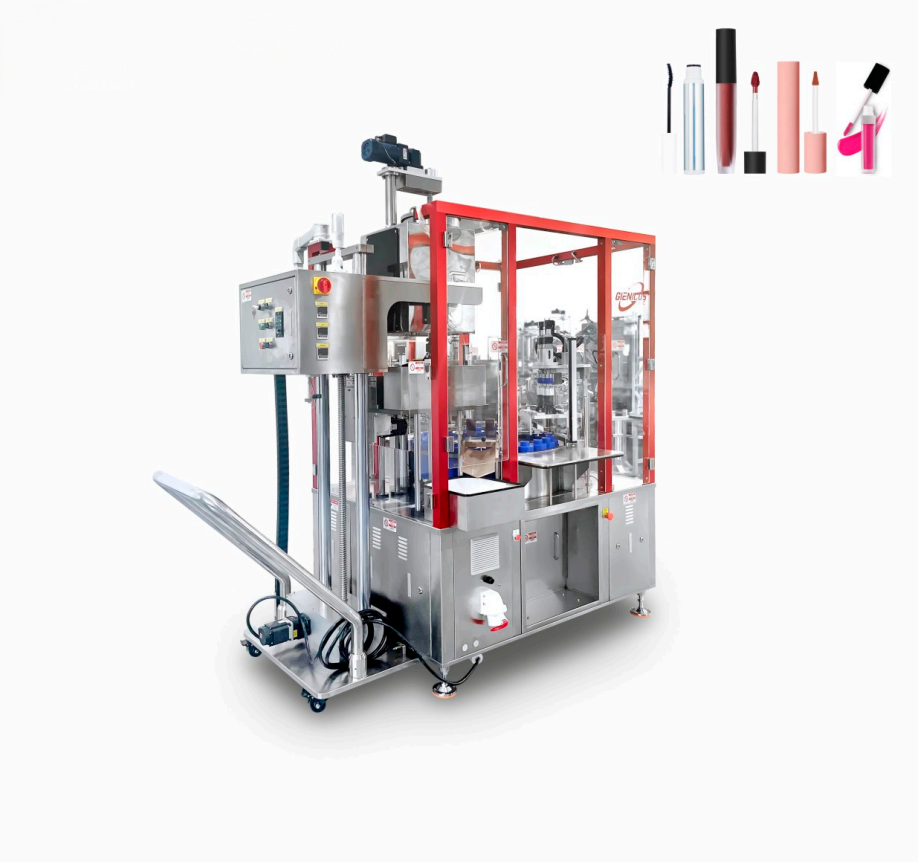
JR-02M/L: dual-nozzle rotary format, 1–20 mL, ±0.1 g, 30–40 pcs/min, with integrated mold detection, rejection and automatic capping.
Next step: send your product format, smallest and largest fill volume, container and cap dimensions, and target output. GIENICOS will map them to a dosing configuration, confirm which CE certificate scope applies to the model, and arrange a sample trial on your own bulk.
Download the full equipment catalogue: 2026 GIENICOS Catalogue (PDF)
Website: WWW.GIENICOS.COM
Email: sales@genie-mail.net | WhatsApp: +86 134 8206 0127
Factory: FL1-2, Building 3, No.1277 Xingwen Road, Baihao AI Technology Park, Jiading North Industrial Park, Jiading District, Shanghai
Have Questions or Need More Details?
Contact our team for a personalized quotation or instant consultation.
Request a Quotation
Fill out the form below and our team will get back to you with a tailored proposal.
WhatsApp Direct Chat
Prefer to chat in real-time? Message us on WhatsApp for instant assistance & quick answers.
- Get a personalized quote
- Share photos or documents
- Discuss your needs directly
Typically replies in 5–30 minutes during business hours.