
Horizontal vs. Rotary Labeling: Choosing the Right Cosmetic Filling Line Match
Horizontal vs. Rotary Labeling: Choosing the Right Cosmetic Filling Line Match
Cosmetic manufacturers often focus on the filling station first, then discover that labeling becomes the real bottleneck when slim lipsticks, mascara tubes, lip gloss bottles, or nail polish vials enter the same production line. The practical choice is usually between a horizontal round container labeling machine and a rotary-type system. Both are valid in a cosmetic filling machine environment, but they suit different container families, precision targets, and integration patterns.
GIENICOS, the brand of SHANGHAI GIENI INDUSTRY CO., LTD., supplies both types of equipment. This article uses actual GIENICOS equipment data to compare application fit, labeling precision, and line integration so that brands, OEM/ODM factories, and contract manufacturers can decide which approach to install next to their existing fill–cap equipment.
The Problem: Labeling Architecture Must Match Container Flow
The deciding factor is not simply labeler speed. In cosmetic packaging, the container shape and the way bottles enter a line determine whether a horizontal labeler or a rotary-type system is easier to justify.
A horizontal round container labeling machine moves slim, cylindrical containers in a horizontal orientation while applying label stock to the body. This is a natural fit for long, narrow cosmetic packages—lipstick, lip balm, mascara, and sunstick—that are difficult to hold upright in conventional wrap-around labelers.
A rotary-type filling system, by contrast, uses a rotating structure to combine multiple packaging operations around a compact turntable. Rotary nail polish filling equipment, for example, can integrate bottle feeding, filling, brush feeding, cap feeding, capping, and discharge into one automatic cycle. The labeler may then be positioned as an upstream or downstream station, depending on whether the product needs fill-before-label or label-before-fill logic.
Industry Background: Automation Is Reshaping Cosmetic Filling and Labeling Decisions
The global cosmetic filling machines market was valued at USD 476.80 million in 2025 and is projected to reach USD 718.63 million by 2036, according to Future Market Insights. Automatic filling machines are expected to account for a 41.2% share of the cosmetic filling technology market in 2026. Asia Pacific also dominated the broader filling machine market with a 33.08% share in 2025, which helps explain why so many global buyers now evaluate machinery from Chinese manufacturers such as GIENICOS.
For buyers, this automation trend does not mean every filling line needs the same layout. It means the fill, cap, and label stages should be designed as one continuous material flow. A horizontal labeler can be added to a linear filling line; a rotary system can reduce the number of manual transfers; and a production line that already runs high-speed cosmetic filling may benefit most from a dedicated labeling module matched to the package geometry.
Detailed Solution: GIENICOS Horizontal Round Container Labeling Machine
GIENICOS supplies the JTB Automatic Horizontal Labeling Equipment for Slim Round Containers. It is intended for cosmetics and personal care manufacturing, specifically packaging for lipstick, lip balm, mascara, and sunstick.
JTB horizontal round container labeling machine key data
- Labeling speed: 0–25 m/min
- Labeling accuracy: ±0.1 cm, excluding container and label variation
- Bottle diameter: 1–2.5 cm
- Bottle height: 2.5–10 cm
- Label width: 1–12 cm
- Label roll inner diameter: 7.6 cm; outer diameter max. 36 cm
- Power: AC 220 V, single phase, 50/60 Hz, 600 W
- Machine dimensions: 200 × 78 × 155 cm (L × W × H)
- Construction: stainless steel and aluminum-alloy structure designed to meet GMP production requirements
The JTB is not intended for large bulk bottles. Its working window—1 to 2.5 cm diameter and 2.5 to 10 cm bottle height—covers the miniature formats that dominate color cosmetics. This is why it pairs well with mascara filling, lip gloss filling lines, lipstick cooling tunnels, and similar downstream stations that handle slender packages.
GIENICOS also offers complementary labeling units for cosmetic packaging. The JTB-815S is an automatic bottom color-code labeling machine designed for lipstick and lip gloss production, and the JSS-01 high speed sleeve shrink labeling machine handles slim and long items such as lipstick, mascara, lip gloss, pencil boxes, and oil bottles. These modules help a cosmetic filling machine area maintain consistent labeling even when containers have different label positions.
Rotary-Type Systems: The GIENICOS JQR-01N Example
Rotary systems are not necessarily labelers. In practice, they are compact automatic lines in which containers move continuously around a rotating platform while filling, brush insertion, capping, and discharge occur at separate stations. A rotary-type system can therefore determine how the filling machine area is organized and whether labeling must be synchronized with a rotating infeed.
GIENICOS JQR-01N(NEW) automatic rotary nail polish filling machine
- Machine type: Automatic nail polish filling machine, rotary type
- Filling methods: piston, vacuum, or pressurized filling
- Container range: 5–30 ml
- Filling precision: approximately ±0.2 g
- Working process: bottle feed → filling → brush feed → cap feed → capping → discharge
- Voltage: AC220V, 1P, 50/60Hz
- Power: 2 kW
- Material: stainless steel
- Application: nail polish, essential oil, perfume, massage oil, and medical oil
The rotary JQR-01N demonstrates the main architectural benefit of rotary systems: multiple handling steps are integrated so operators do not manually transfer containers between fill and cap stations. For small vials, such as 5–30 ml nail polish bottles, this reduces touch points and supports steadier output.
Rotary-type filling is not exclusive to nail polish. GIENICOS supplies the JQR-01A automatic rotary mascara and lip gloss filling machine, which works at about 40–45 PPM with 2–14 ml filling range and ±0.1 g filling precision. In these machines, the rotary structure supports continuous multi-station production for mascara, lip gloss, and foundation liquid.
When a rotary filling machine is already in use, the labeler does not need to be another rotary station. The more important question is whether the package can be transferred to a horizontal labeler after filling or whether sleeve labels, bottom-code labels, and top labels must be applied before the rotary capping process.
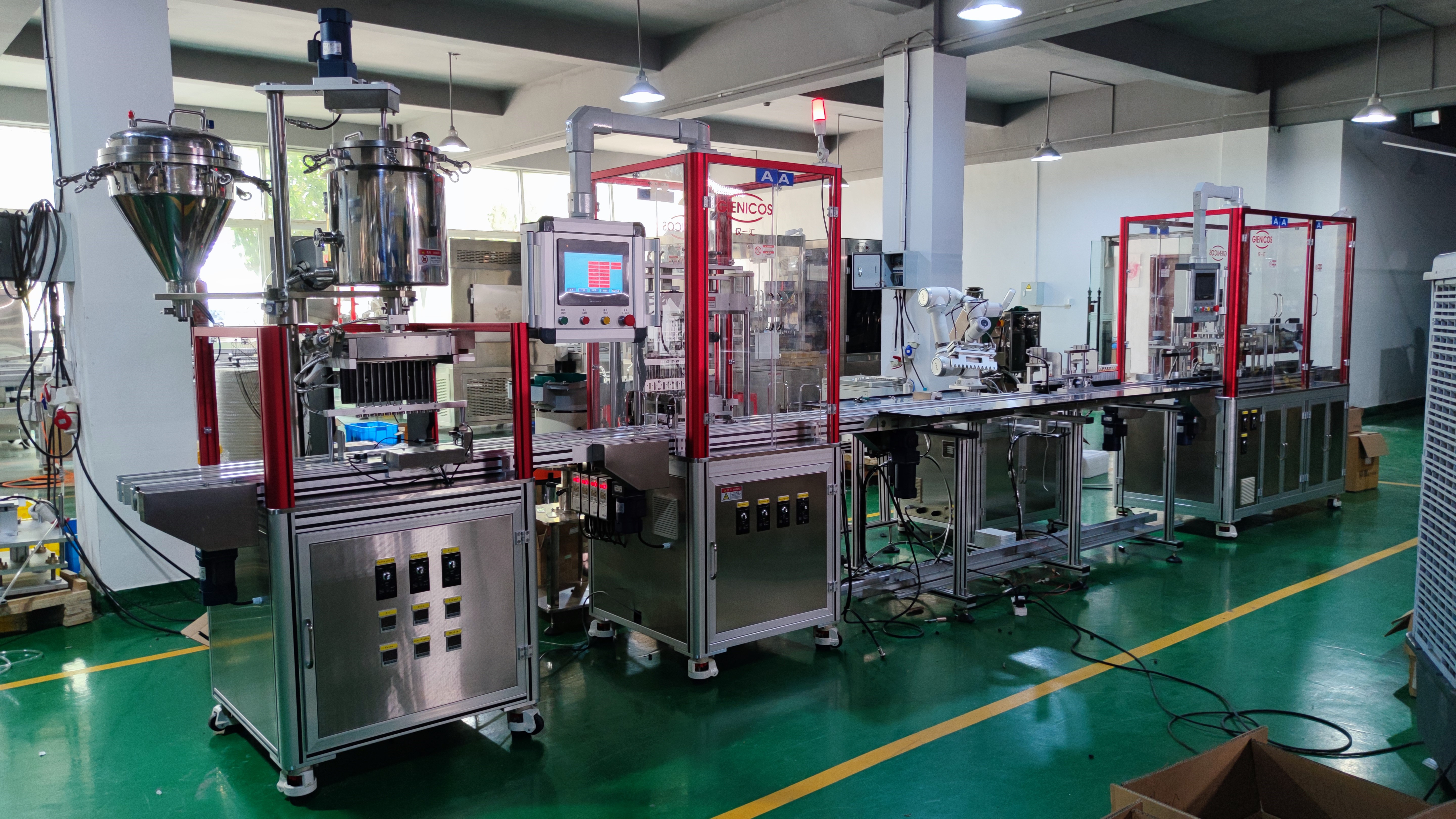
A GIENICOS mascara filling line moves slender containers toward downstream brush insertion, capping, and labeling stages.
Step-by-Step Comparison: Application Fit, Labeling Precision, Integration
Step 1 – Define Your Container Geometry
For lipstick, lip balm, mascara, and sunstick tubes with diameters around 1–2.5 cm and heights from 2.5 cm to 10 cm, a horizontal round container labeling machine such as the GIENICOS JTB provides a direct application path. For nail polish and small oil vials between 5 ml and 30 ml, a rotary-type system such as the JQR-01N is more likely to simplify filling, brush insertion, and capping in one controlled cycle.
Step 2 – Separate Labeling Precision from Filling Precision
Precision requirements should not be mixed. The JTB horizontal labeling machine has a labeling accuracy of ±0.1 cm, excluding container and label variation. The JQR-01N rotary filling machine has a filling precision of approximately ±0.2 g. These two numbers measure different outcomes: label position band versus fill weight consistency. A buying team should therefore ask both questions separately: “Where may the label land on the container?” and “How much product weight variation is acceptable?”
Step 3 – Check Downstream Integration with Existing Fill Equipment
If your line uses a linear high-speed lip gloss or mascara filling machine, bottles usually leave the filler in a straight row and are ready for horizontal labeling. GIENICOS application data for an 80–100 pcs/min lip gloss, mascara, and lip tint production line describes automatic precise filling, automatic wiper loading, and 10-head automatic capping driven by servo motors. In that scenario, adding a horizontal labeler for slender round containers creates a logical sequence: fill → cap → label.
If your line uses a rotary nail polish machine with brush feeding and cap feeding on a turntable, the labeler should be chosen after confirming the bottle orientation at the discharge starwheel. Some rotary lines are better matched with a labeling station that accepts the bottle in a fixed orientation, such as bottom-code labeling or sleeve labeling.
Use Cases: Three Real Production Choices
Use Case 1 – Slim Mascara and Lip Gloss Filling Line
For mascara and lip gloss production at speeds around 60–100 pcs/min, container diameters can range from small slender wands to slightly wider tubes. The JTB horizontal labeler is suitable when the bottle body remains in the 1–2.5 cm diameter range. GIENICOS also offers the JMG linear high-speed lip gloss and mascara filling line, which handles mascara, lip gloss, lip oil, and eyeliner for cosmetic OEM/ODM and brand factories.
Use Case 2 – Lipstick and Lip Balm Molding Area
Lipstick filling often begins with hot-poured wax-based material, followed by cooling and demolding. After demolding, lipstick packages become slim cylindrical products. A horizontal labeling machine can apply body labels after the stick is inserted into the case, while a bottom color-code labeling machine such as JTB-815S can add shade or batch information to the container bottom. This combination reduces the need for a complex rotary labeling turret.
Use Case 3 – Nail Polish and Small Oil Bottles
Nail polish containers are usually short, wide, small-volume bottles rather than long tubes. A rotary-type filling machine like the JQR-01N is a better structural choice because it can feed the empty bottle, fill the formula, insert the brush, feed the cap, tighten the cap, and discharge the finished vial within one rotary cycle. Labeling for nail polish can then be handled by a separate labeling solution matched to the bottle diameter and required label area.
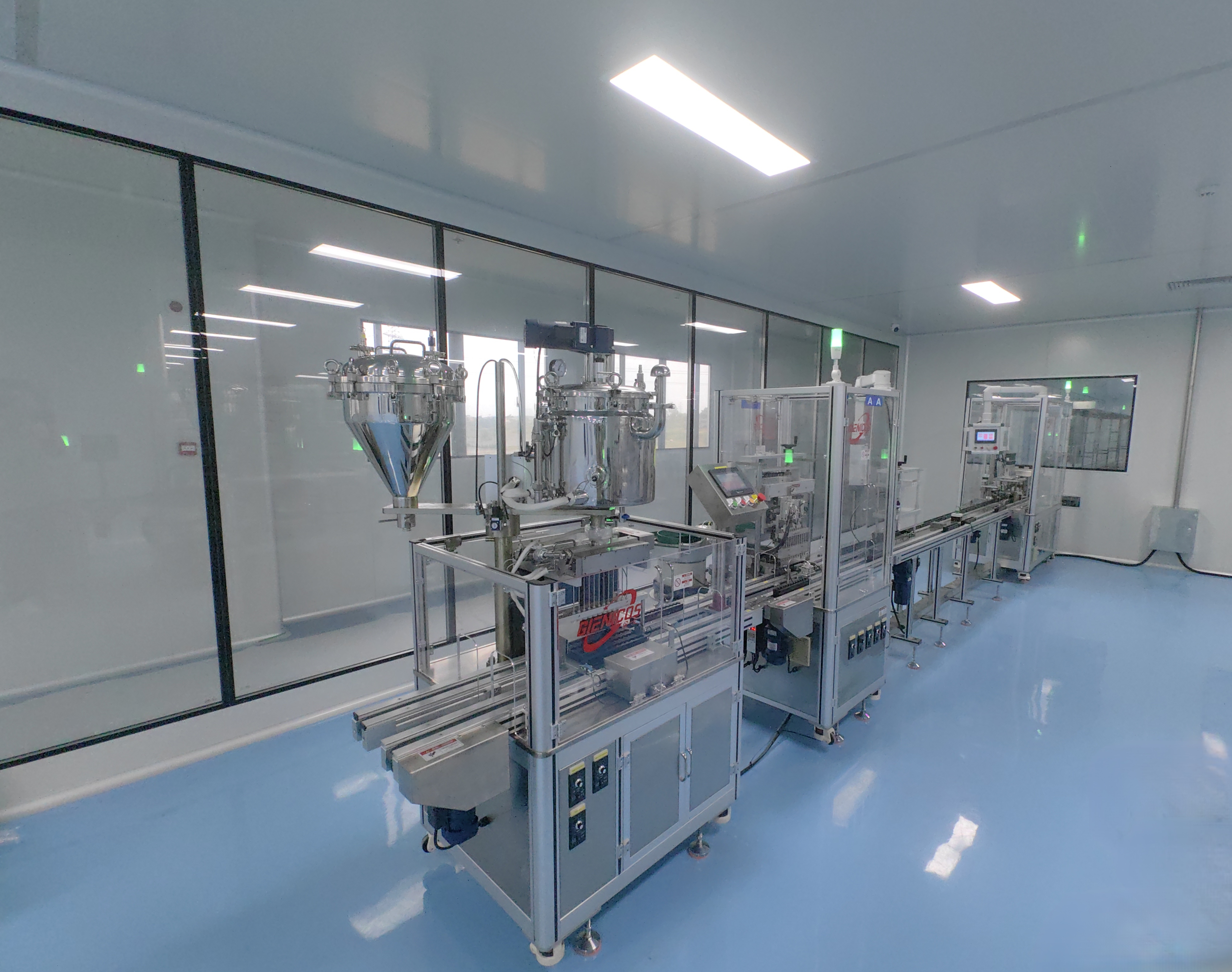
Automatic lip gloss filling production lines benefit from labeling modules selected by container diameter and bottle orientation.
Comparison: Horizontal Labeling Machine vs Rotary-Type Filling System
| Evaluation Point | GIENICOS JTB Horizontal Labeling Machine | GIENICOS JQR-01N Rotary-Type Filling Machine |
|---|---|---|
| Primary role in a cosmetic filling line | Automatic horizontal labeling for slim round containers | Automatic rotary filling and capping line for nail polish and small oil vials |
| Container focus | Bottle diameter 1–2.5 cm; height 2.5–10 cm | Container range 5–30 ml |
| Typical product families | Lipstick, lip balm, mascara, sunstick | Nail polish, essential oil, perfume, massage oil, medical oil |
| Precision specification | ±0.1 cm labeling accuracy, excluding container and label variation | Approximately ±0.2 g filling precision |
| Process integration | Add-on labeling module | Bottle feed → filling → brush feed → cap feed → capping → discharge |
| Line architecture | Horizontal product travel; fits linear filling layouts | Rotary turntable layout; compact multi-station flow |
| Construction | Stainless steel and aluminum alloy; GMP-oriented design | Stainless steel construction |
How to Make the Final Line Decision
Start by separating the filling machine question from the labeling machine question. If the product itself is a slim cosmetic stick or narrow tube, the labeler geometry should be horizontal. If the product is a short nail polish or oil vial, the filling operation can be organized more efficiently on a rotary-type system.
Then confirm how bottles enter and exit each machine. A horizontal labeler usually requires the container to travel with its long axis parallel to the label web. A rotary filler usually requires precise bottle positioning at each station, but the final capped bottle may be delivered in a different orientation for labeling. The equipment supplier should confirm that the discharge height, starwheel pitch, and conveying direction are compatible with your existing or planned filling line.
Finally, think of maintenance and changeover. GIENICOS adopts modular structural design so key assemblies support fast disassembly, convenient cleaning, and spare-part replacement. That modularity is valuable when the same cosmetic filling machine area must run multiple product formats.
FAQ
Are GIENICOS cosmetic filling machines and labeling equipment CE certified?
GIENICOS supplies CE-certified machines across its cosmetic filling and packaging range, including mascara, lip gloss, eyeliner, CC cream, and high-speed filling production lines. Buyers should confirm the specific CE certificate for the exact model they intend to purchase, since certification documentation is normally issued per machine type.
What cosmetic products can GIENICOS filling and labeling machines handle?
GIENICOS equipment is specially developed for color cosmetics and skincare products. Supported products include lip gloss, lipstick, mascara, cushion foundation, compact powder, nail polish, eyeliner, eyebrow pencil, cream, lotion, and similar cosmetic items. The machines are suitable for both OEM/ODM contract manufacturers and brand-owned production bases.
Is a horizontal labeling machine or a rotary-type system better for mascara filling?
Mascara containers are usually slim round bottles, so a horizontal round container labeling machine can be a natural match after automatic mascara filling and capping. GIENICOS also makes rotary mascara filling machines, such as the JQR-01A, which integrates filling and capping on a rotary platform. The final choice depends on whether the entire line is linear or rotary and whether the bottle can be transferred to a horizontal labeler after capping.
Does GIENICOS provide customized labeling and filling line configurations?
Yes. GIENICOS focuses on customized development for key-account clients and upgrades products continuously according to production requirements, formula features, and workshop conditions. Standard mass-produced universal machines are not the company’s main direction. All GIENICOS machines are designed under a module concept, which makes line configuration flexible and easier to adapt to different containers and labels.
Are GIENICOS machines easy to maintain and clean?
Yes. GIENICOS uses modular structural design. Key assemblies support fast disassembly, convenient cleaning, and spare-part replacement, which helps minimize production downtime. Cleanability is an important consideration when the same machine must handle different cosmetic formulations or colors.
What warranty does GIENICOS provide for cosmetic filling machines?
GIENICOS provides a standard 12-month warranty from the date of machine acceptance. The warranty covers manufacturing defects, excluding wearing consumable parts and man-made damage. Free spares and freight are carried by the company according to the warranty terms.
Conclusion
The horizontal versus rotary choice is not a battle between two competing labeler types. It is a decision about the flow of the whole cosmetic filling and packaging line.
Choose a horizontal round container labeling machine when your products are slim, cylindrical, and best labeled while traveling horizontally. GIENICOS’ JTB equipment fits lipstick, lip balm, mascara, and sunstick packaging and provides defined labeling accuracy of ±0.1 cm.
Choose a rotary-type system when your products need compact multi-station processing, such as nail polish vials from 5 ml to 30 ml that require filling, brush feeding, capping, and discharge in one automatic cycle. The GIENICOS JQR-01N rotary nail polish filling machine is one concrete example of this architecture.
For buyers building a complete line, GIENICOS combines its filling machines with complementary labeling modules, including horizontal labelers, sleeve shrink labelers, and bottom color-code labelers. The final match should be based on real container dimensions, required precision, and the orientation of bottles between filling and labeling stations.
Need help selecting the right cosmetic filling machine or labeling module?
Download the latest GIENICOS catalogue to review available filling, capping, labeling, and auxiliary equipment specifications: 2026 GIENICOS Catalogue (PDF).
Have Questions or Need More Details?
Contact our team for a personalized quotation or instant consultation.
Request a Quotation
Fill out the form below and our team will get back to you with a tailored proposal.
WhatsApp Direct Chat
Prefer to chat in real-time? Message us on WhatsApp for instant assistance & quick answers.
- Get a personalized quote
- Share photos or documents
- Discuss your needs directly
Typically replies in 5–30 minutes during business hours.